
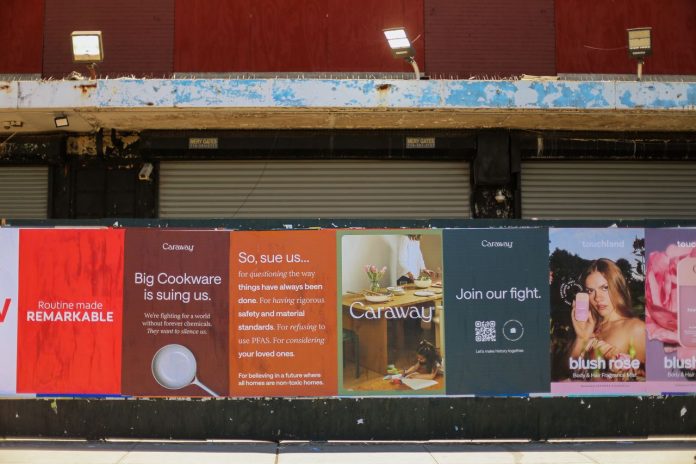

Jordan Nathan, founder and CEO of cookware startup Caraway, sets an annual goal for his team to rally around.
For 2026, that goal was to make Caraway “impossible to ignore,” anchored by splashy initiatives like the company’s first major out-of-home campaign. But the year unfolded in a way Nathan didn’t initially anticipate.
In February, two of the largest players in cookware — Groupe SEB and Meyer — filed a lawsuit against Caraway, accusing the company of false and misleading advertising claims. Both are conglomerates that own and operate multiple brands home cooks would likely recognize. Groupe SEB’s portfolio includes T-fal and All-Clad; Meyer’s includes KitchenAid and Rachael Ray cookware.
At the center of the dispute is how Caraway talks about PFAS in its marketing — a subject drawing growing interest from consumers and state regulators.
As the EPA explains, “PFAS are widely used, long-lasting chemicals, components of which break down very slowly over time.” It’s a catch-all term for a class of man-made chemicals used across a wide range of industrial products, many of which have existed for decades and, because of their persistence, don’t break down easily.
As research on PFAS has expanded — and as the chemicals have become more prevalent in people’s bloodstreams and the environment — consumers are scrutinizing how exposure could affect their health. Companies like Caraway see that as a business opportunity. Nathan said he got the idea for Caraway after experiencing what he called “Teflon flu” — he accidentally left a non-stick pan on the burner too long and said he started to feel sick.
“A call to Poison Control brought shocking clarity,” Caraway’s website reads. “He was experiencing Teflon flu, a reaction to the forever chemicals in non-stick cookware.”
Caraway launched in 2019 with a ceramic cookware set and has since expanded into food storage containers, bakeware, and, last week, a coffee maker that doesn’t rely on plastic.
On its website, Caraway states that its cookware “features a non-toxic ceramic coating that is completely free of PTFE, PFOA, PFAS, lead, and cadmium.”
To differentiate its products, Caraway has gone to considerable lengths to contrast them with cookware already on the market — and that’s what caught the attention of Groupe SEB and Meyer.
In the lawsuit, the two companies accuse Caraway of a “long history of false and deceptive advertising” that has “caused immense and continuing harm to consumers, to plaintiffs, and to other cookware and bakeware companies on the market.” Part of their objection centers on Caraway’s use of the term “toxic cookware” in much of its marketing, which they say implies other cookware on the market is bad for you.
“This lawsuit is about one thing: truthful advertising,” Carmine Zarlenga, a lawyer representing Groupe SEB and Meyer, said in a statement to Modern Retail. “Caraway launched an aggressive advertising campaign making unsubstantiated claims about an entire category of products that federal regulators, including the FDA and the Consumer Product Safety Commission, have consistently found to be safe. When the National Advertising Division of the Better Business Bureau independently reviewed Caraway’s claims and recommended they be discontinued, Caraway agreed but failed to fully comply. Our lawsuit was filed only because Caraway refuses to play by the rules and insists on misleading consumers.”
Rather than staying quiet, Caraway has made the lawsuit the central focus of its marketing strategy this year. Its homepage now features a tab called “Join the Fight,” where shoppers can read about the issue, including links to the original lawsuit and Caraway’s motion to dismiss.
Shortly after the lawsuit was filed, Caraway released a petition urging customers to “Tell Big Cookware: We Don’t Want Forever Chemicals in our Homes.” It put up billboards near a Groupe SEB office in New Jersey reading, “Groupe SEB, go pick on someone your own size.” On LinkedIn, Nathan temporarily changed his title to “sued by big cookware.”
Lawyers took notice. On July 27, Caraway received a cease and desist from Groupe SEB and Meyer demanding that it “immediately cease and desist from its unauthorized, infringing use of Meyer’s and SEB’s registered trademarks and brand logos in Caraway’s advertising, marketing, and promotional materials.” Caraway responded by releasing videos with a disclaimer that it wasn’t affiliated with “big cookware.”
“We felt like it was really our duty to shine a light on what was happening behind the scenes, and also reinforce what Caraway’s mission is,” Nathan said of his decision to keep discussing the lawsuit publicly.
“We have no interest in silencing anyone,” Zarlenga said in a statement. “Caraway is free to market its products however it wishes, as long as its claims are truthful and not misleading. Consumers deserve to make purchasing decisions based on facts, not fear. That is all we are seeking. As to trademark issues, we were pleased to see that Caraway has in essence conceded infringement as we contended through the recent use of a disclaimer to clarify trademark affiliations.”
The debate around how to talk about PFAS
Much of the lawsuit centers on how Caraway talks about PFAS, especially at a time when platforms like Facebook let marketers test dozens of copy variations simultaneously.
The term PFAS doesn’t refer to a single chemical. According to the EPA’s website, “There are thousands of PFAS chemicals, and they are found in many different consumer, commercial, and industrial products. This makes it challenging to study and assess the potential human health and environmental risks.”
Groupe SEB and Meyer’s lawsuit focuses on a few key points. First is how Caraway talks about PTFE, a polymer found in much of the two companies’ cookware.
“Using PTFE-coated cookware and bakeware, under normal conditions, has never been proven to pose any health risks or have any measurable risk of contaminating consumers’ food, homes, or bodies,” the lawsuit states. The companies accuse Caraway of preying on “consumer fears based on problems associated with some PFAS chemicals to deceive targeted consumers into believing they must purchase products that do not contain any chemical, even if it is completely safe, simply because it happens to be a type of PFAS.”
Other allegations stem from how Caraway responded to the National Advertising Division, an industry-led, self-regulatory body within the Better Business Bureau. The NAD investigates what claims can and should be made in advertising, often before any regulatory guidance is issued.
Last year, the NAD investigated certain Caraway advertising claims at the urging of the Cookware Sustainability Alliance, a non-profit whose members include Groupe SEB and Meyer and which describes itself as “dedicated to providing science-based information about the safety of cookware products.”
The NAD recommended that Caraway stop discussing the idea of Teflon Flu “in a context that would suggest that competitor cookware is toxic or is likely to cause Teflon Flu.” The NAD also found that “Caraway has a reasonable basis to claim its cookware is free of PFAS and non-toxic but did not provide sufficient evidence to support comparative claims that competitor cookware is unsafe or less safe.”
“While Caraway has today ceased some of the ads referenced in the NAD complaint, it certainly has not stopped its campaign of misinformation,” the Groupe SEB and Meyer lawsuit alleges.
The lawsuit includes examples of ads that the two companies say repeat false and misleading claims insinuating that non-stick cookware and bakeware from other companies are dangerous. Among the screenshots are Caraway ads with lines like “5 things in your kitchen you didn’t know were toxic,” and “When it comes to keeping you and your family safe from forever chemicals, you can trust Caraway. It’s free from heavy metals, PFAS, PTFE and every other harmful acronym.”
Caraway sees it differently. In its motion to dismiss, Caraway noted that both Groupe SEB and Meyer also sell ceramic cookware that they have promoted in ads as “toxin-free” and “made without PFAS, PFOA and PTFE.”
In emails to Modern Retail, Nathan said the NAD ruling didn’t say Caraway had to stop telling its Teflon Flu origin story. “Its recommendation was about the context in which my story appeared and ensuring we weren’t suggesting that traditional non-stick cookware is likely to cause Teflon flu under normal use,” he wrote. “We adjusted our marketing accordingly.”
Responding to allegations that Caraway “preys on consumer fears associated with some PFAS chemicals,” Nathan acknowledged that “scientists avoid blanket claims that all PFAS have the same risk.” Still, he said, “many scientists and regulators treat PFAS as a class or as subclasses of concern.” He pointed to a recent report from an expert appointed by the United Nations Human Rights Council expressing concern about the potential threat PFAS poses to human rights and environmental justice.
“I believe it’s time to end the use of forever chemicals in cookware and consumer products, where alternatives exist,” Nathan said.
Conflicting messages
The debate over which ingredients or materials belong in a given product — and the shift toward labeling more products “non-toxic” — isn’t confined to cookware. Aluminum-free deodorant brands have multiplied, for instance, even though studies show no clear link between aluminum in deodorant and health complications. Some consumers simply prefer to put fewer ingredients on their skin. Even some athleticwear brands now position themselves as “non-toxic.”
Anita Rao, an associate professor at Georgetown University, has studied what works to debunk misinformation in advertising. In a 2022 experiment, Rao and her colleagues examined three ingredients in categories where consumers are inundated with claims about what’s toxic and non-toxic — aluminum in deodorant, fluoride in toothpaste, and GMOs in nutritional shakes — and what could influence participants’ willingness to purchase. The peer-reviewed research was published in the Journal of Marketing Research.
Participants were randomly assigned to control and experimental groups. The experimental groups received messages designed to “debunk” claims about these ingredients. One message, for example, stated, “Aluminum-containing products are safe for topical use,” to counter the idea that deodorant with aluminum isn’t safe.
The experimental groups saw the same debunking message, but its source varied — a competing company, the media, or a regulator — and in all cases it was delivered as a social media post.
While participants showed increased willingness to purchase deodorant containing aluminum or toothpaste containing fluoride after viewing the debunking message, Rao and her colleagues found that “debunking by regulators is the only source that has a statistically significant effect for all categories.” The findings also suggested companies may be better off releasing competing products than trying to debunk a competitor’s message themselves.
That pattern has played out across categories: In deodorant, major players like Speed Stick and Dove now sell aluminum-free options, while in toothpaste, Tom’s of Maine released a fluoride-free toothpaste in 2012.
“This happens because consumers want products with such claims,” Rao said. In the case of alleged fear-mongering over PFAS, “unless ALL firms coordinate to debunk, … even a few firms highlighting PFAS-free can shift demand toward those firms,” Rao wrote.
Caraway’s marketing engine responds
For Nathan, the decision to respond publicly to the Groupe SEB and Meyer lawsuit was straightforward.
He saw it as a chance to explain Caraway’s mission to more people. “I think we’re still seen as a cookware brand, and we are really a non-toxic home brand,” he said. By responding publicly, Caraway could be seen as the brand fighting for PTFE- and PFAS-free cookware.
Shortly after the lawsuit was filed, Nathan convened an all-hands meeting. “Lawsuits can be scary, but we really mobilized the team,” he said.
One of Caraway’s first public responses was the petition asking for support. “We thought hearing from the consumer was really the best way to affect change,” Nathan said. The petition has drawn more than 50,000 signatures to date. Beyond the billboards near Groupe SEB’s New Jersey office, Caraway ran dozens of wild and digital postings in New York City from May to June, promoting talking points about how “big cookware is suing us” and urging consumers to “join our fight.”
A small group of Caraway leaders now meets every other day to discuss any pivots that are needed, Nathan said.
Now, “every batch of ads we create needs to have some ads that relate to the lawsuit,” he added. Nathan has also been posting about the case on his personal LinkedIn account almost weekly.
Any new development in the lawsuit becomes further fodder for marketing content. Since receiving the cease-and-desist in July, Caraway has leaned into prominent disclaimers stating it is not affiliated with “big cookware,” including a “clarification” quiz on one of its landing pages.
“Caraway’s decision to publicly emphasize the lawsuit is a potentially effective strategy because it can draw attention to the brand and, depending on its consumer base, may be perceived positively,” Rao noted. But, “it also carries risks. If the case is settled or decided in favor of Meyer and Groupe SEB, for example, that outcome could damage Caraway’s credibility and make its messaging more vulnerable.”
Additional lawsuits are another risk. Over the summer, a California resident filed a class-action lawsuit alleging false and misleading advertising by Caraway. “The allegations have absolutely no merit, and we look forward to the opportunity to defeat this Complaint in Court,” Nathan said in a statement.
While the Groupe SEB and Meyer lawsuit plays out in court, Caraway is applying the same marketing playbook to new industries. As it promotes its new coffee maker, plastic — rather than non-stick coating — is now the target.
“Contaminant detected: plastic, in your coffee,” Caraway said in one
promoting its new product. “New York, we have clean coffee,” the brand wrote in a for a launch event. A spokesperson for Caraway said the first batch of coffee makers has sold out, and the product has generated more than seven figures in sales since launching on September 22.
“Caraway is one of a million voices today talking about forever chemicals,” Nathan said. “I personally feel like one out of every like five Reels on my Instagram is [about] plastic or forever chemicals. … Consumers are increasingly wanting healthier materials and consumer products.”


