
Pinterest is rolling out a new set of advertising tools and user-facing features as it positions itself for the AI era.
Announced at the “Pinterest Presents” event on Tuesday, the features will launch over the coming weeks. Chief among them is Visual Search Ads, which lets brands place sponsored products directly in search results and Pin close-ups — the detailed view users see after tapping a Pin. Pinterest’s automated advertising suite, Pinterest Performance+, is also gaining manual A/B testing tools, and advertisers can now choose which products to prioritize during key moments such as a seasonal launch.
CEO Bill Ready framed these updates as evidence that Pinterest has become a full-funnel marketing platform. Speaking to advertisers, he said users arrive on Pinterest with “clear intent” but before they have decided what to buy. “That is the magic moment for a marketer to meet a potential customer,” he said. “For much of our history, Pinterest was a great place to build awareness, but not to drive results. I’m proud to say that Pinterest is now a performance platform, … and AI is powering all of it.”
Pinterest executives argue the opportunity for brands is substantial, largely because the platform’s audience is both growing and young. More than half of Pinterest’s users are Gen Z, and 640 million people now use Pinterest every month. According to the company, users conduct more than 80 billion searches per month, more than half of which relate to buying a product or finding a specific item. Nearly all searches — 96% — are unbranded, leaving ample room for brands to capture demand.
“Pinterest is where people come to decide what to try, buy or do next,” Lee Brown, Pinterest’s chief business officer, said. “People come here before their decision is made. They don’t even know how to describe what they want, but they know it when they see it. … We can anticipate that next idea and help your brands become the answer people are looking for.”
Pinterest has introduced a steady stream of ad tools in recent years to drive engagement and revenue. “Pinterest is having a bit of a rebirth,” Tinuiti’s Jack Johnston told Modern Retail in 2024. “What we’re seeing in the first quarter of this year is everyone came out of the gate incredibly strong, so Pinterest investment was up 45% agency-wide.”
In turn, brands that once stopped advertising on Pinterest have started making room for it in their marketing budgets. Over the last three years, paid clicks to advertisers on Pinterest have grown 5X, Brown said. He noted that Pinterest users are more receptive to ads because they are actively seeking inspiration — whether for a new couch or retro sneakers. “When your ad shows up, it isn’t standing between them and what they came for,” he said. “It is what they came for.”
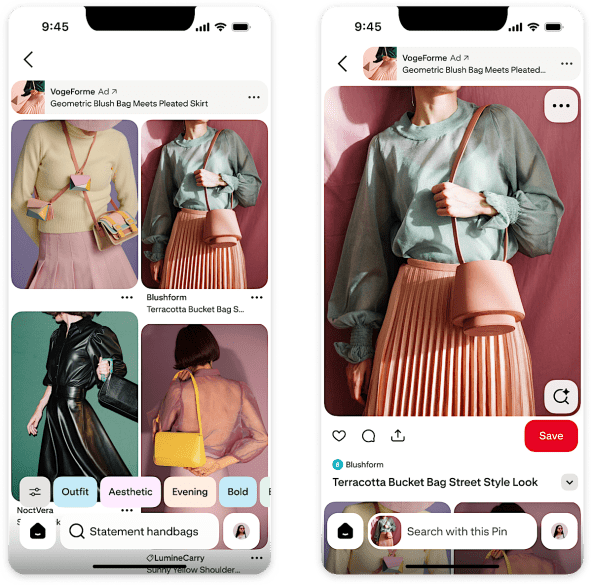
Visual Search Ads illustrate the shift. The format is rolling out in beta across markets worldwide. If someone searches Pinterest for, say, “statement handbags,” they may soon see a sponsored result for related products, then click through and buy from the merchant’s site. The tool is “a major step forward in helping brands drive measurable lower-funnel outcomes with the campaign assets that they already have,” said Chloe Wix, vice president of go-to-market at Pinterest. “No net new creative required.”
Pinterest Performance+, the company’s AI-powered performance advertising suite, is also getting an upgrade. It debuted in beta in 2024 and now offers more controls to steer brands “toward the outcomes that matter most,” Wix said. A brand can specify how much it wants its ads to reach new customers, or prioritize certain products for the holidays. Brands can also build integrations with their own apps to promote installs.
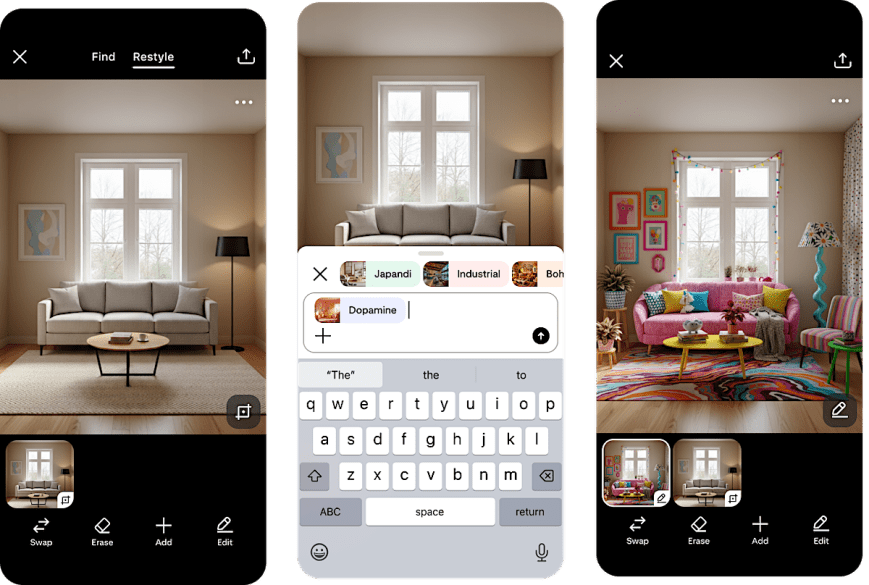
On the consumer side, Pinterest is adding features that let users interact with brands. One is Restyle, a camera function that uses Pinterest Intelligence to help people reimagine their space. A user can photograph their living room, for example, then use Restyle to preview a different aesthetic — such as “bohemian” or “industrial” — and buy the products associated with it, like lamps or tiles. Restyle will launch soon in beta in the U.S. and Canada.
Alongside these new functions, Pinterest is encouraging brands to work with creators such as interior designers and chefs. In June, Pinterest began allowing creators to connect their Amazon storefronts to Pinterest, keeping their affiliate links intact. “More than 80% of Pinners feel the content on Pinterest is informed by expert opinions,” said David Brinker, Pinterest’s global head of content. “Brands that partner with creators on Pinterest have seen higher return on ad spend in sales and stronger brand awareness.”
Connected TV is another piece of the strategy. Pinterest acquired tvScientific, a CTV advertising platform, in February, and advertisers can now run standalone CTV campaigns through Pinterest. In March, the company launched “Bring My Pinterest to Life,” a CTV show on Roku in which Pinterest users work with creator-hosts to redecorate rooms or change their wardrobes. Each episode included QR codes leading to Pinterest boards filled with shoppable products from brands such as Wayfair and Michaels. The show is now filming its second season, slated for release in 2027.
Even as many of Pinterest’s new tools rely on AI, executives on Tuesday also sought to distance the platform from so-called “AI slop.” In recent years, users have complained about the volume of AI content on the platform, including images and recipes. Last year, Pinterest added the ability to reduce AI-generated images in categories such as “architecture,” “beauty,” and “food and drink.” Pinterest also says that for users under 18, it automatically disables data sharing for generative AI training.
In his presentation to advertisers, Ready said the platform is committed to using AI safely as parents and young people push back against the technology’s spread. “You didn’t build this, and nobody in this room wants to advertise in a place that harms kids,” he explained. “You just haven’t had an alternative. If you wanted reach, you invested in the biggest platforms, whether or not you liked how they operated.”
The implication for brands is that they can feel better about advertising on Pinterest: the platform has AI guardrails in place and encourages people to do things in real life, like plan a dinner party or hold a game night. In May, Pinterest rolled out an ad calling out “the cost of being constantly online.” (The company showed the ad again on Tuesday.) Chief Marketing Officer Claudine Cheever said in her presentation that searches for analog activities and “dumb phones” are up more than double on Pinterest.
Still, Pinterest remains a digital platform — and one that relies on AI to fuel its ad targeting and visual search algorithms. Earlier this week,
it was expanding its partnership with Pinterest to allow the platform’s conversational AI tool, Pinterest Assistant, to process “25X more visual context per request.” Ready has also spoken about the importance of so-called open-weight artificial intelligence models, or AI models whose core components are released to the public and available for download.
Last month, Pinterest reported that its second-quarter sales rose 18% from $998.2 million a year earlier. Pinterest’s global monthly active users jumped 11% year over year, while its global average revenue per user was ahead of projections. The company expects revenue for the next quarter to come in between $1.19 billion and $1.21 billion.


