
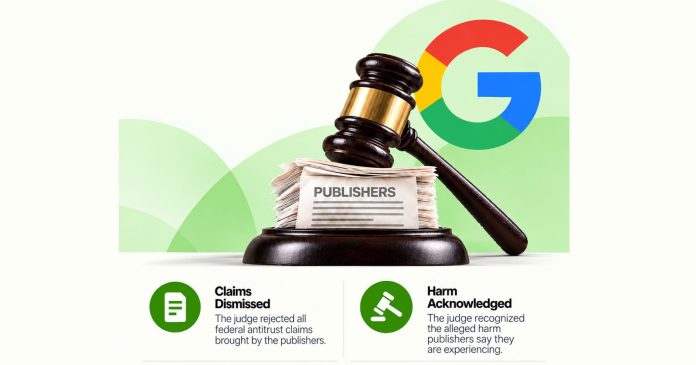
A federal judge has dismissed amended antitrust complaints brought by Chegg and Penske Media against Google, even while acknowledging the harm publishers say they experience. In the Penske case, the order grants Google’s motion to dismiss without prejudice and states that the ruling is final and appealable.
The Judge Acknowledged Publisher Harm
The order states plainly that publishers and their employees are suffering, and the judge notes he is not unsympathetic to their position.
He wrote:
“The court does not treat Plaintiffs’ alleged harms lightly. Nor is it unsympathetic to the situation publishers now find themselves in, and the knock-on consequences to journalists, educators, and other online creators whose content Google takes and repurposes without compensation.”
Why the Case Was Dismissed
The dismissal did not rest on a finding that publishers suffered no harm. Instead, the plaintiffs’ allegations failed to meet the requirements of federal antitrust law, and the judge found they did not establish their monopolization claims.
The Five Categories of Claims Rejected
The judge rejected all five categories of claims brought by the plaintiffs:
- Reciprocal dealing
- Tying
- Unlawful monopoly maintenance
- Attempted monopolization and monopoly leveraging
- Unjust enrichment
Reciprocal Dealing
Reciprocal dealing describes an arrangement in which two parties agree to exchange business with each other. Here, the theory was that publishers let Google crawl and index their content, and Google returns referral traffic in exchange.
The judge ruled that the plaintiffs did not plausibly allege an actual agreement in which Google traded search traffic for publishers’ content. Their pleadings did not assert a plausible “agreement,” lay out its elements, or explain the circumstances under which it arose. Judge Mehta also noted missing elements such as communications between Google and the plaintiffs showing that an agreement was negotiated or discussed.
He explained the core failure this way:
“Plaintiffs have pleaded only that they have an “expectation” that Google will send them search traffic if they make their content available for free. But an expectation is not an agreement.”
Tying
Tying occurs when a company uses its power over one product to force customers to accept a second, separate product. Penske did not plausibly establish that Google Search and AI Overviews are distinct products with separate consumer demand.
Unlawful Monopoly Maintenance
The judge also found that publishers lacked standing to challenge Google’s alleged monopoly maintenance in the general search services market. In this context, standing means the plaintiffs had not suffered the type of injury required to bring that antitrust claim.
The judge explained:
“To survive a motion to dismiss, Plaintiffs must plausibly establish that they have antitrust standing as to these claims. As with other plaintiffs appearing before this court, they have not.”
He offered additional detail for the ruling:
“Plaintiffs claim to be participants in the general search services market with antitrust standing under two theories. First, Plaintiffs fashion themselves as “suppliers” of Search Index Data in the market for general search services and “purchasers” of Search Referral Traffic.
Alternatively, and simultaneously, Plaintiffs argue they have standing because their injuries are “inextricably intertwined” with the injuries suffered by Google’s new AI competitors in the general search services market…
Neither theory persuades.”
Attempted Monopolization and Monopoly Leveraging
The plaintiffs did not clearly define the publishing markets Google was allegedly trying to dominate, nor did they adequately show that Google was likely to monopolize them.
Judge Mehta explained:
“By failing to define plausible markets, Plaintiffs do not make out a necessary element of their attempted monopolization claims. Their monopoly leveraging claims fall for the same reason. Both claims also suffer from other basic pleading deficiencies.
Count V of Chegg’s Amended Complaint and Count VI of the PMC Plaintiffs’ Amended Complaint must be dismissed.”
The memorandum opinion goes into considerable detail to explain the ruling:
“…Chegg’s claim would still fail because it has not plausibly pleaded that Google has a dangerous probability of monopolizing a market in which it participates.”
Of Penske’s claim he writes:
“What’s more, this market definition, even if the court were to accept it, renders implausible their attempted monopolization theory.
Indeed, the PMC Plaintiffs do not even attempt to quantify Google’s market share in online publishing or offer a single fact to support their allegation that Google has a dangerous probability of monopolizing the sweeping market they describe.”
Unjust Enrichment
Once the federal claims were dismissed, the judge also dismissed the California unjust enrichment claims rather than decide them in federal court.
Judge Mehta explained:
“Having dismissed all federal claims in these actions, the court has discretion to either exercise supplemental jurisdiction over the remaining state law claims or decline to do so.
(dismissing all federal law claims and declining to exercise supplemental jurisdiction over remaining state law claims, including unjust enrichment). In exercising this discretion, the court considers “judicial economy, convenience, and fairness to litigants.
In the typical case in which all federal-law claims are dismissed, the “‘balance of factors to be considered . . . will point toward declining to exercise jurisdiction over the remaining state-law claims.'” “
What the Ruling Does and Does Not Say
Judge Mehta’s decision will be disappointing to publishers and SEOs who believe Google is abusing its dominant position in search. A careful reading of the memorandum shows the dismissal turned on the plaintiffs’ failure to allege facts meeting the requirements of federal antitrust law—not on a finding that publishers suffered no harm.
The ruling means the complaints, as pleaded, did not satisfy the legal requirements for those antitrust claims.
Featured Image by OpenAI Generated


