

AI makes it easy to produce more content, faster. Few people need convincing that AI has created real efficiencies for brands, agencies, and anyone whose job involves scaling content production.
If you know the “good, fast, cheap” project management triangle, you know the common wisdom: you can only pick two. That trade-off applies to AI-generated content in many situations too. But none of us sets out to create something that isn’t good or that fails to move the goals we’re measured on.
In AI Overview SERPs, even visible brands can waste effort when research lacks discipline. This process focuses specifically on AI Overviews, the biggest current intersection of AI and SEO in Google, but the same discipline extends to LLM visibility in tools like ChatGPT and Perplexity (with a roadmap for that in a future article).
To protect the “good” while keeping “fast” and “cheap” in play, here is the step-by-step roadmap my agency team runs for clients. Borrow whatever fits your own workflow.
Step 1: Start From The Business Objective
Before opening any research tool, you need to know what your definition of “good” is anchored to. Every potential keyword, topic, or concept must map to a business outcome — a lead, ecommerce revenue, or another trackable metric that matters to your organization.
Visibility or traffic alone is rarely a deep enough goal, unless your business model is specifically built on brand awareness or pageviews. Media companies monetizing through ads are typically the exception; most businesses I’ve worked with are not.
Take a relationship-driven third-party logistics provider. It wants leads from businesses that aren’t shopping for the lowest cost to ship from point A to point B. It wants companies with complex needs, seeking a tailored solution and an ongoing relationship. For that business, content wins when it drives website lead form conversions that the sales team turns into booked business and realized revenue over the life of the relationship.
Whatever your business type and deepest mappable goal, getting crystal clear on it comes before tools and data. If you struggle to define and quantify that goal, you risk producing a lot of content that never delivers the return on investment stakeholders expect.
See also: How To Define & Report SEO KPIs That Actually Move The C-Suite
Step 2: Build The Keyword Universe And Run A Content Gap Analysis
My team uses Ahrefs for SEO and AI search research (we’ve used other tools in the past), so the examples below come from there. Substitute your own platform as needed.
Step 2 builds the foundation: the keyword universe you’ll run content gap analysis against.
The Ahrefs tasks for this step:
- Open Competitive Analysis > Content Gap from the top nav.
- Enter your domain in the target field and add at least two to four competitors (up to 10), then click “show keyword opportunities.”
- Read the results — keywords your competitors rank for that you don’t. Hover over a position number to see the specific competitor page ranking for it.
- Filter for readability using the upper filters for KD and volume and the lower filters to set ranking position ranges (e.g., competitor ranks top 10, you don’t rank).
- Click a specific intersection between two competitors to narrow the comparison further.
- Export the filtered output to your working sheet — that export becomes the input for clustering in Step 4.
Judgment matters throughout, especially in the second task. Competitor selection is a decision, and you need “search” competitors: the sites you go up against for search visibility, not necessarily the competitors your sales or product teams talk about internally. The list of product/service competitors is often different from the list of search competitors.
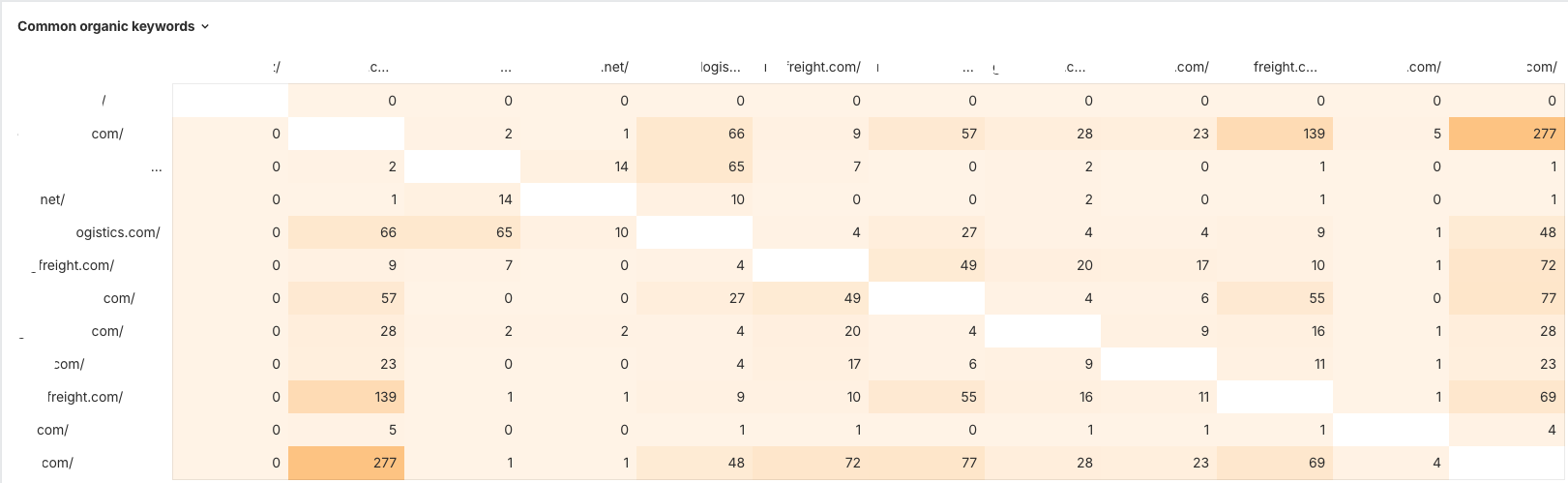
Also note that the raw output isn’t a to-do list. Expect a large chunk to be branded, off-intent, or irrelevant. That’s another human call to make here.
Sticking with the 3PL example: the head term “3pl” sits at KD 47 and 29,000/mo. Tempting, but difficult and broad. Meanwhile, “3pl fulfillment” is KD 11 at 2,600/mo and “3pl companies” is KD 18 at 5,000/mo, both with much more defined B2B intent. Aim big with goals, but in content, there are sweet spots to hit before you take on the top industry term.
See also: Why Search Volume Is Screening Out Your Best Content Opportunities
Step 3: Read The SERP, Not Just The Keyword (The AI Search Step)
Volume and KD help determine whether you can rank. They don’t tell you what ranking is worth. In an AI search SERP, the first organic spot can sit below an AI Overview and other search features, including ads, so the same position today can deliver a fraction of the clicks it once did. Ahrefs found the top-ranking page loses roughly 58% of its clicks when an AI Overview is present. That makes knowing what the SERP actually looks like — including how often AI Overviews appear — essential before committing to a term.
The Ahrefs tasks for this step:
- In Keywords Explorer, open a keyword ideas report (e.g., “matching terms”) for your shortlist from Step 2.
- Apply the filter SERP features > Include > AI Overview to isolate the terms that trigger an AI Overview.
- To see where you already show up, go to Site Explorer > Organic keywords and filter SERP features > Current > Include target in > AI Overview (this surfaces terms where your pages are already cited, or not, inside AI Overviews).
- Click into the SERP overview for your priority terms to see the full feature set (AI Overview, People Also Ask, ads, local pack — and who’s being cited in the AI Overview).
- Record each keyword’s SERP features on the roadmap (SERP features column) so Step 5 can account for it.
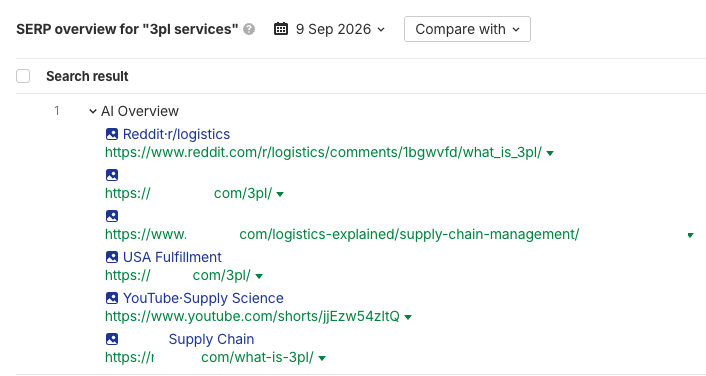
These tactical steps are spelled out, but where AI Overviews appear is where you need to slow down and make a judgment call. It’s not an automatic “skip” scenario. For each term, decide whether the AI Overview changes whether you target it at all or just how you write for it. Some logic to factor in: for informational, top-of-funnel terms where an AI Overview dominates, you won’t get as many clicks. Depending on your priorities, you might write to be cited in the AI Overview, or focus on the organic result that appears below it.
In the 3PL example, an AI Overview appeared on nearly every B2B term we looked at in our logistics roadmap (“3pl companies,” “3pl fulfillment,” “third-party logistics companies”). That reality shaped the entire content plan: visibility on those terms means getting cited in the AI Overview and setting realistic SERP expectations for performance and traffic overall.
See also: When AI Takes The Click, Click Worthiness Should Guide Your Strategy
Step 4: Cluster And Group
A keyword list isn’t a plan. You get value from this work when you match how AI systems actually read topical authority — building around clusters and topics, not one-off pages chasing single keywords. To prioritize well, build topics first.
The Ahrefs tasks for this step:
- In Keywords Explorer, open the Matching terms report for your seed terms and use the clustering view (Ahrefs can cluster by Parent Topic — keywords that share the same top-ranking page — or by shared terms).
- Use Parent Topic clustering to find where several keywords can be served by one page versus where they truly need separate pages.
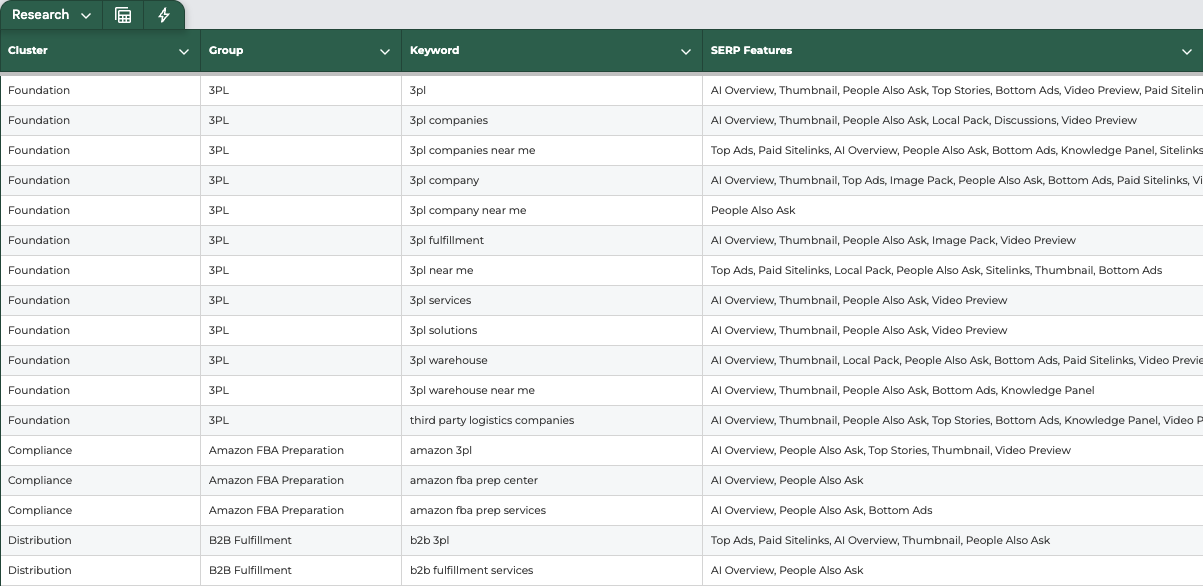
- Bring the clusters into your working sheet and organize them (Cluster > Group > Keyword — the structure our roadmap uses).
- Working sheet columns: Cluster, Group, Keyword, KD, Volume, Intent, and SERP Features
- Map each cluster to a specific destination (a hub page, service page, or article) so every cluster has a home on the website.
This step holds another judgment call. The tool clusters by ranking overlap; your focus is clustering by business meaning. Ahrefs will sometimes split terms you’d serve with one page, or group terms that deserve their own pages. Intervene and decide whether a cluster maps to a real buyer intent and a page you’d actually build — not an arbitrary statistical grouping from the tool.
Back to the 3PL company: terms rolled up into clusters like Foundation > 3PL (core service terms: “3pl companies,” “3pl services,” “3pl warehouse”) and a separate Compliance > Amazon FBA Preparation cluster (“amazon 3pl,” “amazon fba prep center”). Those are two different buyer intents needing different pages, even if the tool sees them as adjacent. The FBA cluster is bottom of funnel with a specific need, not a variant of the general “3pl” terms.
Step 5: Prioritize: Difficulty × Potential × Intent × AI Overview Reality
Now you decide what gets built and in what order. Bring together the four things gathered so far: difficulty (can we win), potential (is it worth winning), intent (does it map to the objective), and AI Overview reality (what’s a click actually worth). Tools are valuable, but no tool quantifies or scores this for you — this is the human layer.
The tasks for this step:
- In your sheet, line up each cluster’s keywords with volume, KD, intent stage, and the SERP features (AI Overview) note from Step 3.
- Score against the Step 1 objective first — proximity to a lead or revenue matters more than volume.
- Tier your roadmap with a Foundation set you build first (winnable + high intent), then everything else behind it.
- Flag terms where an AI Overview means you’re optimizing to be cited rather than to earn a click, so expectations — and the brief you’ll complete in Step 6 — are correct.
This step is far more human decision-focused than tool-heavy. Your reasoning needs to hold up for the plan to connect to your goals. A high-volume, low-KD term can still lose to a lower-volume term that sits closer to a lead conversion.
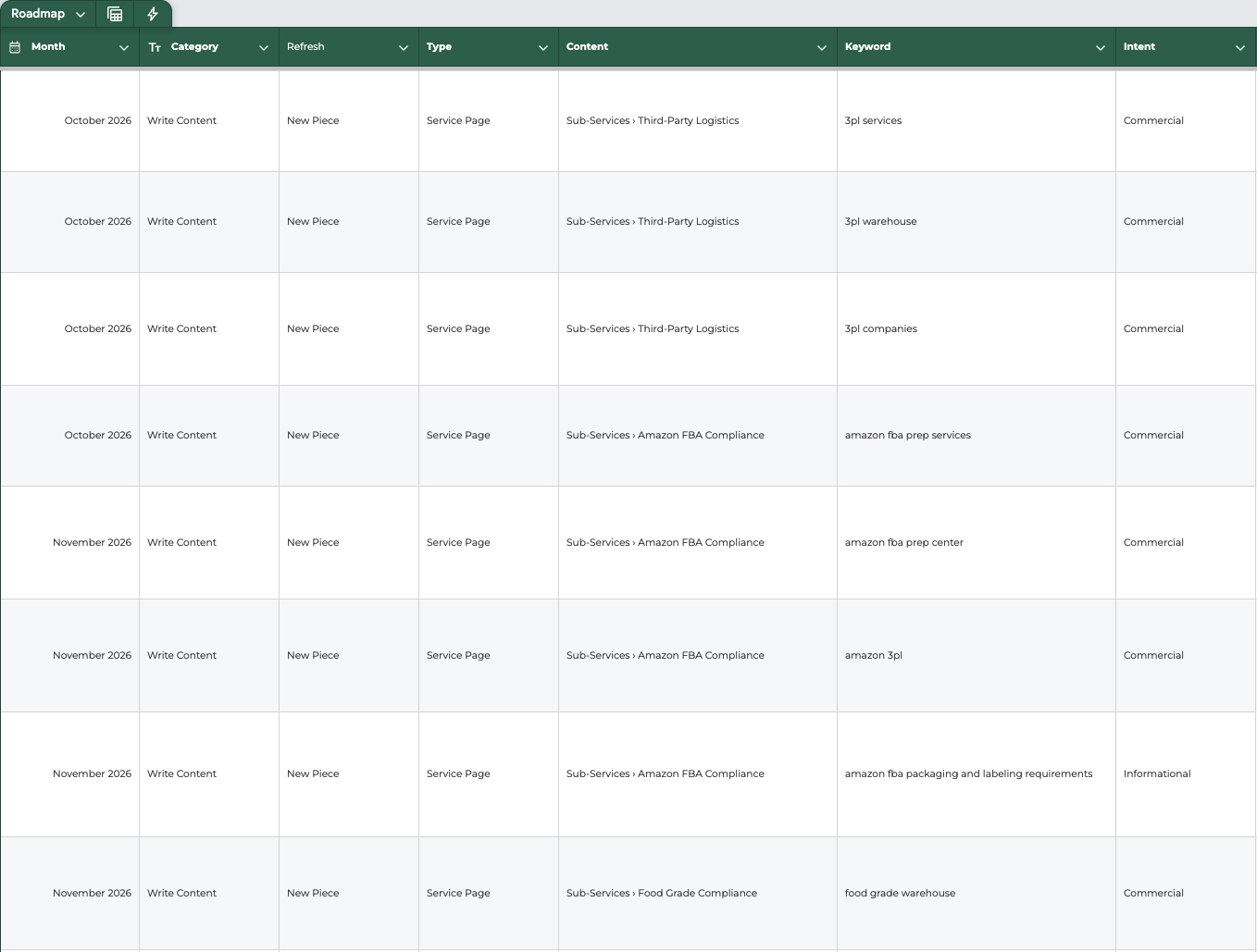
In the 3PL example, instead of leading with the tempting “3pl” (broad, mostly informational intent, AI Overview dominated), we prioritized more winnable, higher-intent terms into Foundation — “3pl fulfillment” and “3pl companies.” We pushed the Amazon FBA prep cluster up the list because searcher intent is closer to buying, even with fewer searches per month. Volume was the last tiebreaker, not the first filter.
Step 6: Hand Off To The Brief And Write For AI Visibility
A roadmap proves valuable only when it turns into the content it’s designed to create. In the current search landscape, that means building with an understanding of AI Overviews and LLM answers with citations — not just ranking in blue links.
Tasks for this step:
- Turn each prioritized cluster into a brief (primary keyword, supporting cluster/terms, intent stage, SERP features note, target page, and angle).
- Write to be citable: lead each section with a direct two- to three-sentence answer to the question, then support it. Use headings that mirror how people actually search while keeping answers concise enough to be lifted.
- Be specific in ways AI systems reward — real expertise, concrete detail, named entities, data. These are the things that are fast and cheap but not good; AI-created pages can’t fake them.
- Add the technical layer (schema/structured data, internal links from the cluster’s supporting pieces to the hub).
In this last step, you’re making final judgment calls after the tools have done their work. AI can accelerate the brief and the first draft, but real examples, expertise, point of view, and human editorial judgment are what create credibility and resonate with the human reader. The “good” we’re protecting is our defense against competitors who chase fast and cheap with AI-only content that can’t replicate our expertise.
Good, Fast & Cheap Starts With A Baseline
At this point, the mythical trifecta of good, fast, and cheap feels closer. You may need to step back from your roadmap, briefs, and completed work to see it, but the priority you’ve placed on “good” while scaling for fast and cheap is worth recognizing.
What changes with this approach — or with borrowing any missing elements into your existing one — is that research targets the AI SERP, not just the traditional blue link SERP. You’re optimizing for citation alongside intent and position. This process focuses on AI Overviews, but the roadmap extends to LLM citation sources, so keep in mind how a structured approach helps with LLM visibility too.
As AI SERP features continue to dominate, the cost of skipping this discipline increases. Generating visibility without a mapped business outcome or ROI component is a newer way to waste time and dollars on SEO and AI optimization — and it’s harder to catch, because impressions and rankings can still look healthy in analytics and reporting.
Two things to do with this roadmap and work.
First, determine your baseline. Capture your current SERP feature and click data before AI features shift significantly again, so you can track progress from this point forward. Click details and the math will look different now than a couple of years ago, and different again in the future.
Second, don’t try to change your whole content operation at once. Test this method by picking one cluster, running it through these steps before you brief your next content piece, comparing how it performs to something built the previous way, and using that learning to decide how you move forward with this — or any — framework.
More Resources:
- From Organic Search To AI Answers: How To Redesign SEO Content Workflows
- Why SEO Roadmaps Break In January (And How To Build Ones That Survive The Year)
- How To Create An SEO Roadmap That Actually Drives Results
Featured Image: Master1305/Shutterstock


