
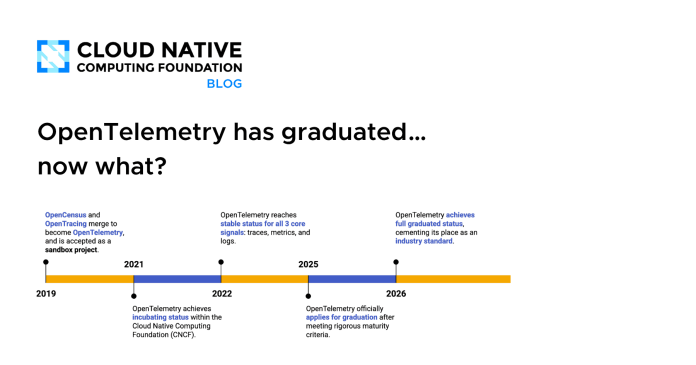
OpenTelemetry Has Graduated: What Changes and What Comes Next
If you missed the announcement: OpenTelemetry (OTel) has officially achieved CNCF graduated status. It now stands alongside established open source projects like Kubernetes and Prometheus. The journey has been long, and the community is excited. But what does graduation actually mean, and where does the project go from here? To understand the future, it helps to look at the past.
How We Got Here: From Fragmentation to a Unified Standard
Not long ago, telemetry signals had no common standard. Every vendor created and maintained its own instrumentation libraries with proprietary formats. Switching vendors meant stripping out one set of libraries from your code and replacing them with another — a costly, time-consuming effort that kept teams locked in.
Traces, logs, and metrics were also treated as separate concerns, with no straightforward way to correlate them. That left a significant gap in the observability story: you could see individual signals, but not how they related to each other in a single transaction.
Two earlier projects laid the groundwork for a solution: the CNCF’s OpenTracing and Google’s OpenCensus. Each approached standardization from a different angle, setting the stage for what would become OpenTelemetry.
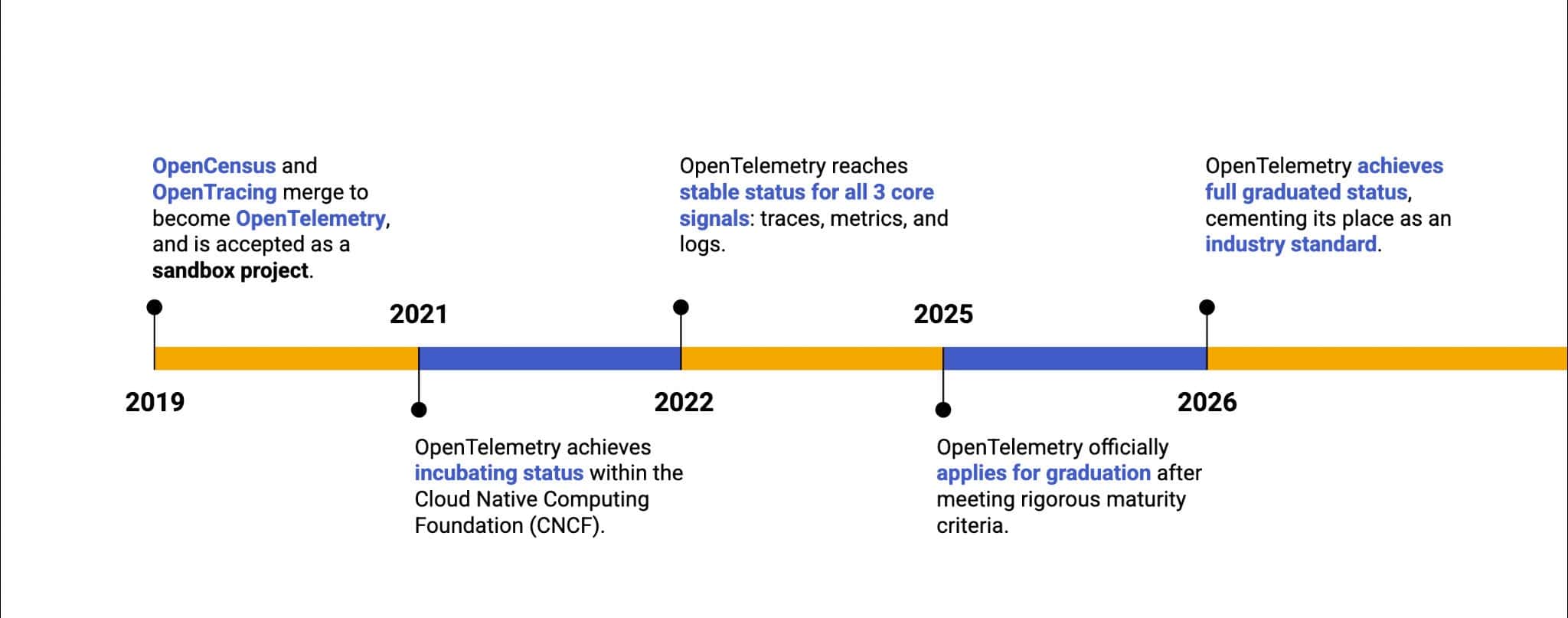
In May 2019, OpenCensus and OpenTracing were merged to form OpenTelemetry. The project took the best ideas from both and expanded on them, delivering a specification for traces, metrics, and logs, a set of standardized APIs, and language-specific implementations of those APIs, alongside the Collector.
Both predecessor projects are now officially archived: OpenTracing in January 2022 and OpenCensus in July 2023.
With support from major observability vendors and an active community of developers and end users, OpenTelemetry became the de facto open standard for telemetry.
Project Growth and Momentum
OpenTelemetry is the second-highest velocity project in the CNCF, behind only Kubernetes. According to the CNCF, the project has “over 12,000 contributions, from over 2,800 companies and hundreds of maintainers across various language-specific Special Interest Groups (SIGs).”
The core signals — traces, logs, and metrics — have reached general availability. Profiling has been added as a new signal. The OpenTelemetry Demo continues to grow, and the OTel Collector gains new components on a regular basis. The ecosystem has also expanded with tools designed to improve ergonomics, including OpAMP, the OTel Operator, OTel Weaver, and OTel Arrow.
That level of activity is remarkable for a project that is only seven years old. It signals that OpenTelemetry is not a passing trend, and graduation reinforces that message.
What Graduation Required
OpenTelemetry started its path to graduation in 2025 and achieved graduated status in May 2026. The CNCF’s graduation criteria are demanding, and the project had to demonstrate strength across several dimensions:
- Production adoption. Many different organizations, such as GitHub and , run OpenTelemetry in production.
- Robust governance. OTel has a documented governance model with clearly defined roles around election and retirement, along with transparent communication and decision-making.
- Community health. OpenTelemetry has an established process for PR review and management. The project has a number of regular contributors across multiple organizations. Reviewers are responsive, ensuring that issues and fixes are addressed in a timely manner.
- Security. OTel has undergone at least one independent security audit, and all critical issues identified have been remediated.
- API stability. APIs are stable, properly versioned, and released at a regular cadence, with backwards compatibility ensured so as to not break existing implementations.
- Documentation. OTel’s documentation provides an architectural overview, along with user, operator, and contribution guides.
- TOC application and review. A graduation application template was submitted for review by the CNCF’s Technical Oversight Committee (TOC). You can check out OTel’s submission.
A great deal of behind-the-scenes effort went into this achievement, involving OTel maintainers, end users, and CNCF TOC members alike.
Special recognition goes to Austin Parker, OpenTelemetry Governance Committee member and former Community Manager, who led the graduation effort with the CNCF. The entire OpenTelemetry community shares credit for making this milestone possible.
What Graduation Means for Your Organization
What does OpenTelemetry graduation mean for you?
Dan Gomez Blanco, one of the maintainers of the OTel End User SIG, put it well in a recent LinkedIn post:
For end users, this graduation signals that OTel is far from being an “emerging standard”. Its contributor health, security and quality standards, governance processes, and wide adoption have been evaluated to be at the level required by any enterprise, of any scale. So, if you’re in the 25% of skeptics not using OTel, there’s really no excuse anymore. There has never been a better time to adopt it!
In short: OpenTelemetry is production-ready and fully open for business. For organizations that were waiting for a sign of maturity before adopting, this is it.
What’s Next for OpenTelemetry
Software is never truly “done,” and OpenTelemetry will continue evolving across the specification, API & SDK, and Collector.
One clear area of focus is observability for new types of workloads, such as agentic workflows. The emerging generative AI semantic conventions are being developed to address this. The project is also turning attention to areas that previously received less focus, including browser and mobile observability.
For more mature teams, the need is for guidance on using OpenTelemetry at scale. Tools like Weaver help teams define and govern their telemetry schemas. The project is also simplifying rollouts by packaging components into installable modules through OpenTelemetry Packaging, and enabling zero-code instrumentation with the OpenTelemetry Injector.
OpenTelemetry has a long future ahead, but that future depends on continued work from maintainers, contributors, and the end users who adopt and support the project.
The community is looking forward to what’s next, and there’s plenty of room for new participants to get involved.


