
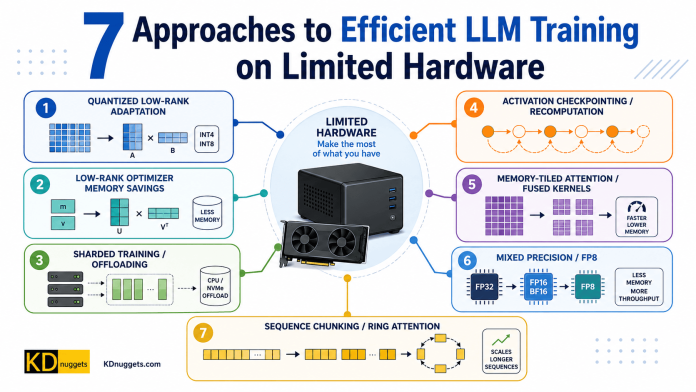
How to Train Large Language Models on Consumer GPUs Without Running Out of Memory
Scaling laws suggest that training multi-billion parameter foundation models requires clusters of H100s connected by high-speed InfiniBand interconnects. In practice, though, many engineering teams work with budget-capped hardware: dual or quad workstation GPUs like RTX 4090s, A10Gs, or L40Ss, constrained by consumer-tier PCIe bandwidth and VRAM ceilings of 24 GB to 48 GB per device.
The standard approach to training—initializing a 16-bit model with the default AdamW optimizer and default autograd graph retention—fails quickly under such limits. A 7B parameter model in FP16/BF16 requires 14 GB of VRAM for static weights alone. Adding AdamW optimizer states, which use 8 bytes per parameter for first and second moment estimates in FP32 (roughly 56 GB for a 7B model), plus gradient tensors (14 GB in FP16) and dynamic activation memory that grows with context length, an out-of-memory error occurs before the first step completes.
To train models within hardware constraints, separate Static Memory Overhead (weights, optimizer states, persistent gradients) from Dynamic Transient Memory Overhead (intermediate activations, scratchpad buffers). Also determine whether the bottleneck is Compute-Bound (Tensor Core utilization) or Memory Bandwidth-Bound (VRAM read/write round-trips).
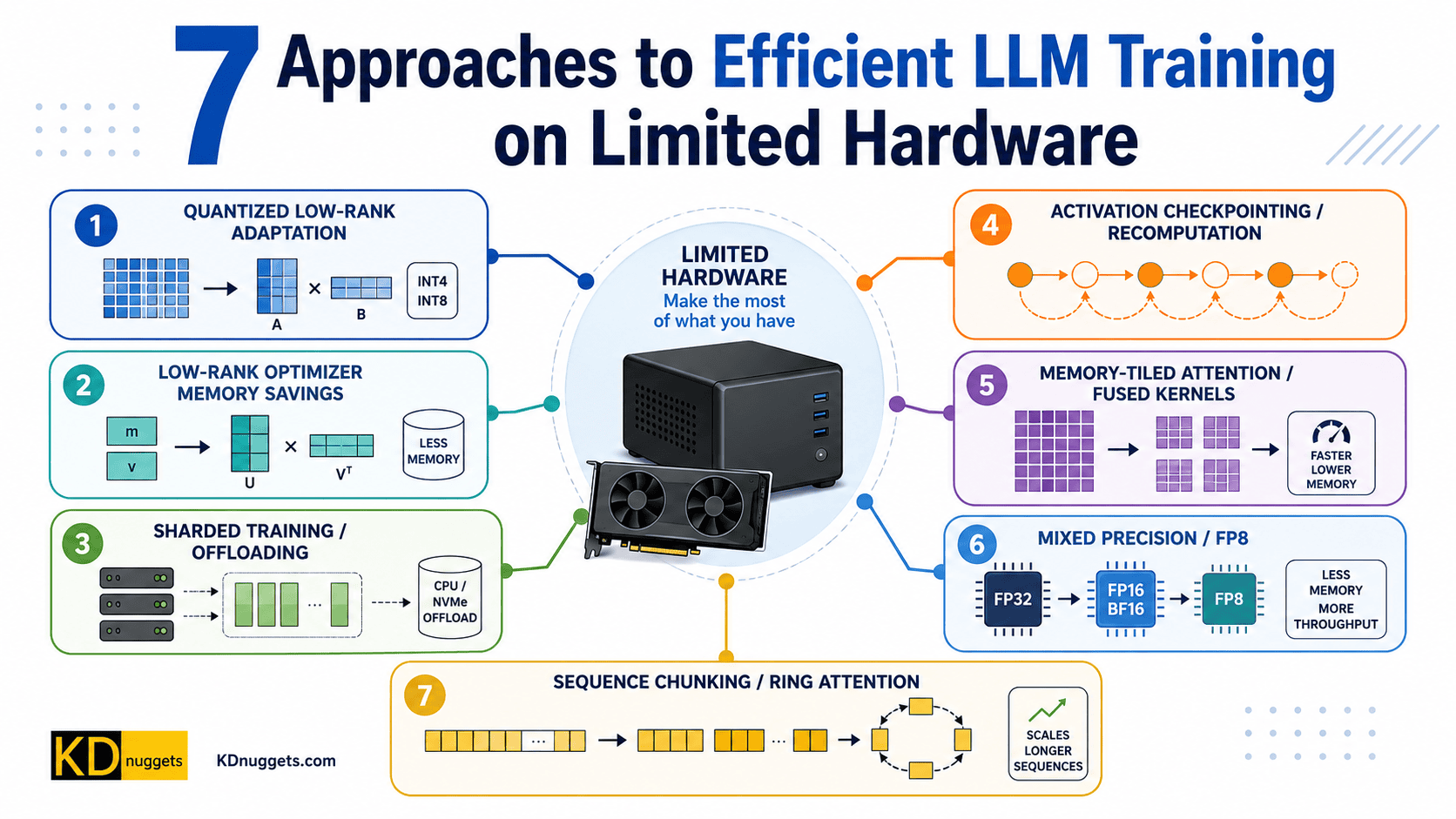
1. Quantized Low-Rank Adaptation (QLoRA and DoRA)
What It Does: Freezes base model weights in a 4-bit representation and injects trainable low-rank, full-precision decomposition matrices into attention and feed-forward layers.
How It Works: Base parameters are quantized into 4-bit NormalFloat (NF4), designed for normally distributed neural network weights. Double Quantization (DQ) further compresses the quantization constants themselves, saving an additional 0.37 bits per parameter. During the forward pass, base weights are dequantized to BF16 for computation, combined with the low-rank update ΔW = B·A (scaled by α/r), then discarded from cache. Weight-Decomposed Low-Rank Adaptation (DoRA) extends this by separating magnitude and direction updates to more closely replicate full fine-tuning behavior.
Trade-offs: Dequantizing weights on the fly adds compute overhead, reducing throughput by roughly 20% to 35% compared to native 16-bit training. Merging adapters back into base weights for inference also requires returning the model to 16-bit precision, so direct 4-bit deployment isn’t feasible without precision loss.
Best For: Fine-tuning 7B to 70B models on a single or dual 24 GB consumer GPU where aggregate VRAM can’t accommodate full-precision weights and gradients.
2. Memory-Aware Low-Rank Optimizers (GaLore)
What It Does: Projects high-dimensional gradient matrices into a low-rank subspace, cutting optimizer memory usage without freezing any layers.
How It Works: AdamW stores two FP32 values per parameter—first and second moments—consuming 8 bytes per parameter. Gradient Low-Rank Projection (GaLore) applies Singular Value Decomposition (SVD) or randomized projections to the gradient tensor G ∈ ℝm×n, maintaining momentum and variance only for projected matrices P ∈ ℝm×r where r ≪ min(m, n). Projections refresh periodically (every T steps) to spread SVD cost across iterations.
Trade-offs: Periodic SVD computation causes step-latency spikes. Hyperparameters are sensitive: poor choices for update frequency T or rank r can destabilize training and trigger sudden loss divergence.
Best For: Full-parameter pre-training or domain adaptation on memory-limited hardware, especially when LoRA-style methods don’t capture complex out-of-distribution features.
3. Fully Sharded Data Parallelism with Host Memory Offloading (FSDP / ZeRO-3)
What It Does: Distributes optimizer states, gradients, and parameters across both GPU VRAM and system RAM, paging tensors over PCIe on demand.
How It Works: Under ZeRO-Stage 3 or FSDP Full Shard, each GPU holds only 1/N of the model state. Before the forward pass, an all-gather collective reconstructs layer weights, then releases them once compute advances. In host-offload mode, inactive parameter shards and optimizer states live in pinned CPU memory, streaming over PCIe asynchronously via non-blocking CUDA streams.
Trade-offs: Consumer PCIe Gen4/Gen5 bandwidth creates serious I/O bottlenecks. If GPU compute finishes before host-to-device transfers complete, streaming multiprocessors idle, dropping utilization below 30%. PCIe contention can also starve dataloader workers reading training batches from NVMe drives.
Best For: Training models larger than combined GPU memory on a multi-GPU node—for example, a 30B+ parameter model across four 24 GB cards.
4. Selective Activation Checkpointing and Recomputation
What It Does: Discards memory-heavy intermediate activations during the forward pass and recalculates them selectively during backpropagation.
How It Works: Standard training stores every intermediate activation for gradient computation. Selective activation checkpointing identifies operations that use lots of memory but little compute—like GeLU/SwiGLU activations, layer norms, and dropout masks—and frees them after forward execution. During the backward pass, these tensors are recomputed from the nearest checkpoint boundary, typically a transformer block.
Trade-offs: Full recomputation adds roughly 30% to total FLOPs per step. Naive implementation without profiling allocation lifecycles can also cause CUDA memory fragmentation, triggering out-of-memory errors even when total VRAM usage appears within limits.
Best For: Training with long contexts (8k to 32k+ tokens) where activation memory grows linearly or quadratically and exceeds static weight allocations.
5. Hardware-Aware Memory-Tiled Kernels (FlashAttention-2 and Fused Operations)
What It Does: Restructures attention and elementwise operations to run within fast on-chip SRAM, minimizing slow reads and writes to GPU HBM.
How It Works: Standard attention materializes the full N×N matrix S = QKT in HBM, driving massive memory traffic. FlashAttention-2 tiles Q, K, and V into blocks that fit in SRAM/L1 cache, computing softmax incrementally through online scaling—no full attention matrix ever touches global memory. Fused kernels combine LayerNorm, bias adds, and activations into single kernel launches, reducing memory round-trips.
Trade-offs: Fused kernels are tied to specific GPU architectures (Ada Lovelace, Hopper, Ampere) and compute capability flags. Compiling FlashAttention on non-standard drivers or containers can trigger ABI issues, silent fallback to slower native kernels, or precision underflow with unaligned sequence lengths.
Best For: Any transformer workload, regardless of scale, to maximize SM occupancy and eliminate memory bandwidth bottlenecks.
6. Mixed-Precision Training with FP8 (E4M3/E5M2) Formats
What It Does: Runs matrix multiplications in 8-bit floating point, halving memory bandwidth and activation buffer sizes compared to 16-bit formats.
How It Works: Uses two FP8 variants: E4M3 (1 sign, 4 exponent, 3 mantissa bits) for activations and weights to favor precision, and E5M2 (1 sign, 5 exponent, 2 mantissa bits) for gradients to support wider dynamic range. Per-tensor or per-tile scaling factors are computed at runtime to prevent underflow and overflow before casting values into FP8 Tensor Cores.
Trade-offs: FP8’s dynamic range is narrow. Without delayed scaling or per-channel quantization, gradients can vanish in deeper layers, causing loss explosion and unrecoverable divergence. FP8 acceleration is also limited to recent architectures like Ada Lovelace or Hopper.
Best For: Training on RTX 4090, L40S, or H100 hardware where FP8 Tensor Cores roughly double compute throughput and halve activation memory use.
7. Sequence Chunking and RingAttention Over Commodity Interconnects
What It Does: Splits ultra-long sequences across devices, passing KV blocks in a ring pattern concurrently with attention compute.
How It Works: Instead of loading an entire 64k+ token sequence into one GPU, RingAttention chunks the sequence along the time dimension across K devices. Device i computes attention between its local Q and KV blocks, then launches asynchronous P2P communication to send its KV block to device (i+1) mod K while receiving from (i-1) mod K. Compute and network transfers overlap completely, removing the need for NVLink meshes.
Trade-offs: On consumer hardware over PCIe or 1GbE/10GbE networks, communication latency often exceeds compute time for small batch sizes. When network transfer outpaces block computation, the pipeline stalls at each ring step, erasing throughput gains.
Best For: Scaling training context windows beyond 32k tokens on multi-node or multi-GPU systems without dedicated high-bandwidth interconnects.
Key Takeaways for Training LLMs on Limited Hardware
Long-running training on constrained hardware surfaces silent failure modes that benchmarks miss: non-deterministic CUDA behavior across driver versions, thermal throttling under sustained 100% duty cycles, and checkpoint corruption from async disk I/O bottlenecks. Production pipelines need continuous monitoring of floating-point underflow rates, PCIe bus utilization counters, and automated gradient checks to avoid wasting hundreds of compute hours on silently diverged weights.
Training LLMs on limited hardware is fundamentally a memory hierarchy problem, not a brute-force compute problem. By decoupling weight precision, optimizer state tracking, and activation persistence through QLoRA, GaLore, and FlashAttention-2, engineering teams can approach convergence parity with enterprise-scale clusters at a fraction of the hardware cost.
Vinod Chugani is an AI and data science educator focused on practical applications for working professionals. His work covers agentic AI, machine learning applications, and automation workflows. As a technical mentor and instructor, Vinod has guided data professionals through skill development and career changes, bringing analytical insight from quantitative finance into his teaching. His content emphasizes actionable frameworks professionals can apply immediately.


