
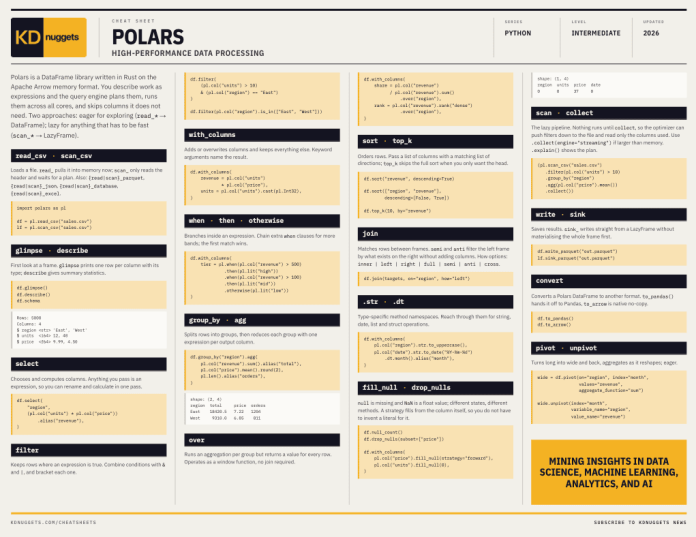
Polars is a DataFrame library written in Rust on the Apache Arrow memory format, and the speed comes less from the language than from the model: describe your work as expressions, and the Polars query engine plans them out.
<!– –>
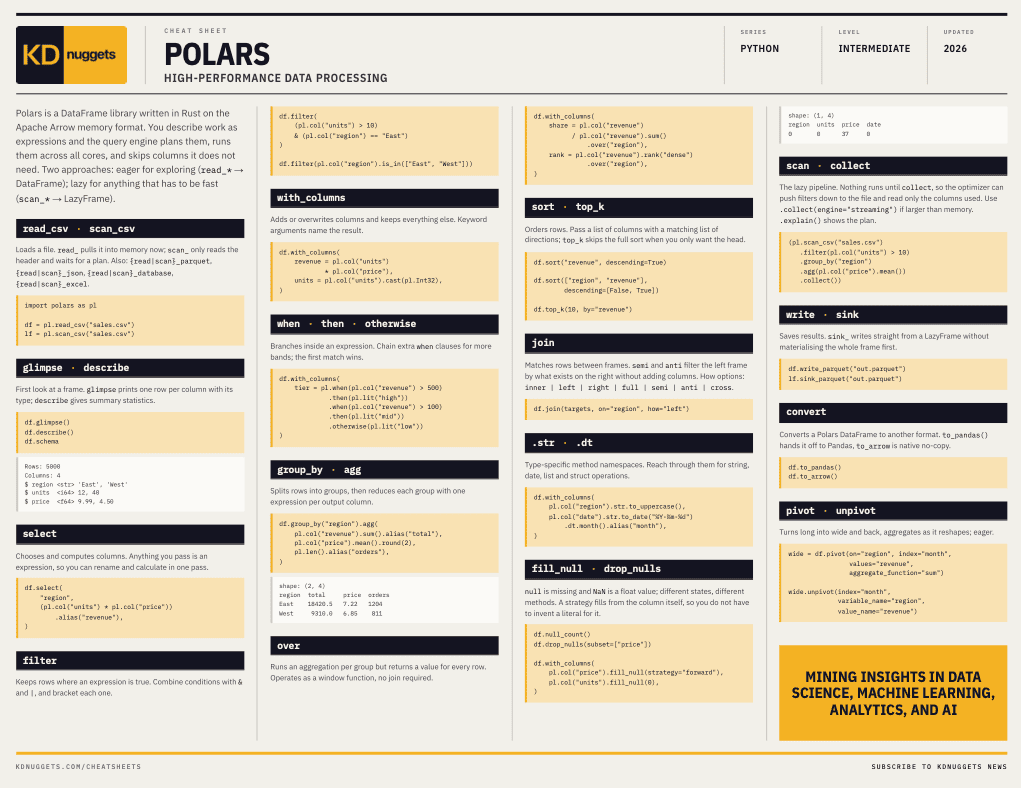
Most people arrive at Polars after a specific kind of frustration: a dataset that fits on disk but not in memory, or a transformation that runs on one core while the other fifteen sit idle. Polars is a DataFrame library written in Rust on the Apache Arrow memory format, and its speed comes less from the language than from the model. That model works by letting you describe your work as expressions, which the Polars query engine then plans and executes across all available cores while skipping unnecessary columns. The latest KDnuggets cheat sheet covers the foundational functionality you need to get the most out of Polars.
That model is easiest to see in scan_csv and collect. Where read_csv pulls a file into memory immediately, scan_csv reads only the header and waits. Everything you chain after it is a description of intent; nothing executes until collect, which gives the optimizer room to push your filters down to the file itself and read only the columns your pipeline actually uses. For files larger than memory, collect(engine="streaming") processes in chunks rather than giving up.
The second big idea to know from the jump is over. It runs an aggregation per group but returns a value for every row, so calculating each region’s share of its own total, or ranking within a category, needs no separate groupby-and-join treatment. It behaves like a window function that reads like a normal column expression.
There is a small distinction that causes outsized confusion, so it is worth settling early. In Polars, null means missing and NaN is an actual float value. They are different states with different methods, and expecting them to behave as one thing is a common early stumble.
Beyond those, the cheat sheet covers the full working surface. There is the core verb set of select, filter, and with_columns; grouping and reshaping through group_by, agg, pivot, and unpivot; conditional logic with when/then/otherwise; joins including the semi and anti variants that filter without widening a frame; the .str and .dt namespaces for type-specific operations; and the output side, where sink_parquet writes straight from a lazy frame without materializing it first. There is also to_pandas and to_arrow, because adopting Polars rarely means abandoning everything already built around Pandas.
Download our Polars: High-Performance Data Processing cheat sheet and start working faster and more efficiently right away.
<!–
Our Top 5 Free Course Recommendations
–>

Get the FREE ebook ‘KDnuggets Artificial Intelligence Pocket Dictionary’ along with the leading newsletter on Data Science, Machine Learning, AI & Analytics straight to your inbox.
By subscribing you accept KDnuggets Privacy Policy


