
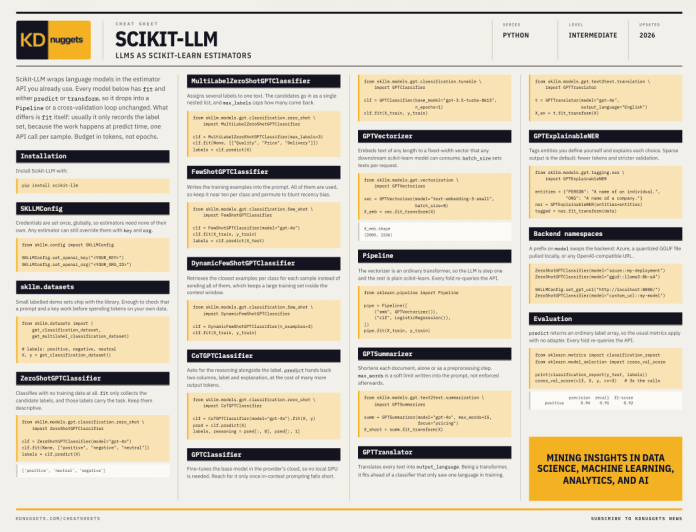
Scikit-LLM wraps language models in the scikit-learn estimator API, so it drops into a Pipeline or a cross-validation loop natively.
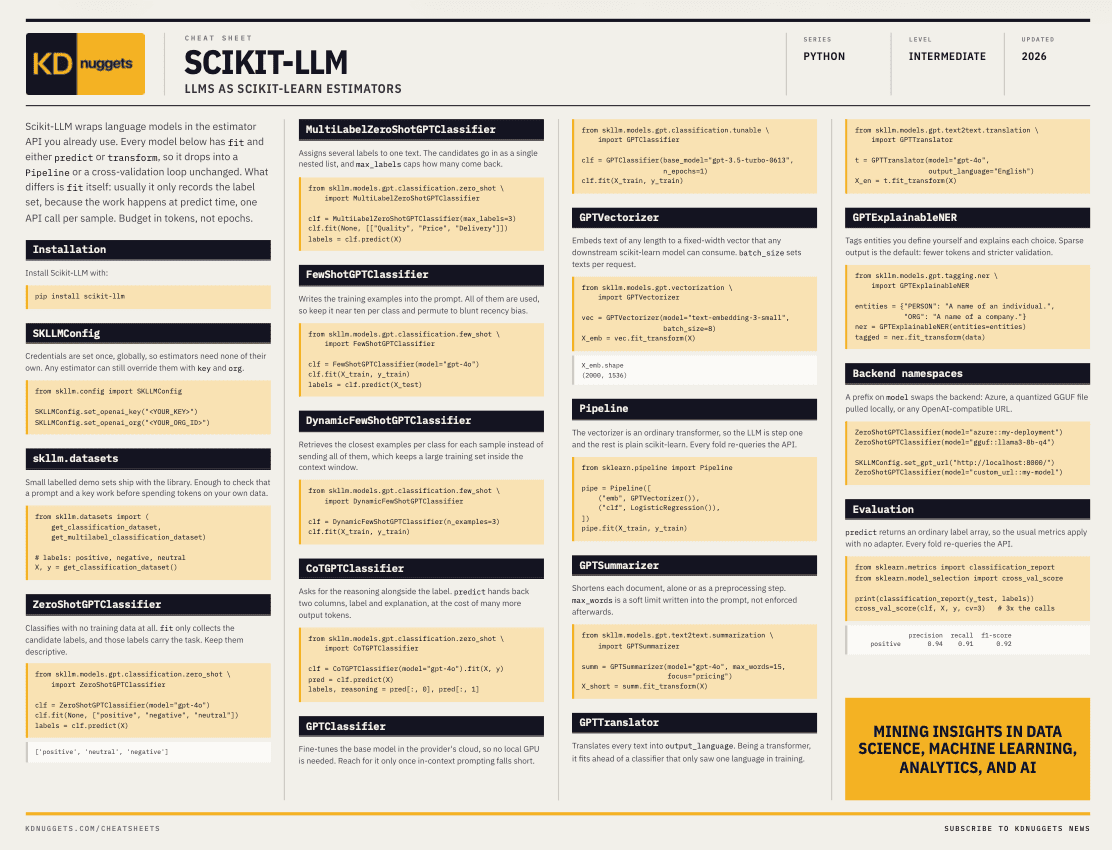
You have two practical routes for integrating LLMs into a traditional machine learning workflow. One keeps scikit-learn in charge, with pipelines, cross-validation, and a metrics report at the end. The other turns into a script full of loops over API calls, string parsing, and a try/except wrapped around a response that occasionally came back as prose instead of a label. Both perform classification, but only the first produced an approach worth reusing.
Scikit-LLM closes that gap by wrapping language models in the scikit-learn estimator API you may already be using everywhere else. Every model exposes fit plus either predict or transform, so it drops into a Pipeline or a cross-validation loop natively. What actually differs is fit: it usually just records the label set, because the real work happens at predict time in one API call per sample. That means you can think and plan in tokens, which is the idea this new cheat sheet is built around.
The estimator you will likely reach for most is ZeroShotGPTClassifier, and it takes a while to get comfortable with it. Calling fit(None, [...]) with nothing but candidate labels feels wrong the first few times, until you accept that the labels are the task specification. Vague labels produce vague results, so treat them as descriptions rather than single words. When zero-shot isn’t enough, DynamicFewShotGPTClassifier is a better default than plain few-shot, since it retrieves the closest examples per class per sample instead of loading the entire training set into every prompt.
Other estimators are worth knowing too. GPTVectorizer turns text of any length into a fixed-width vector, so the LLM becomes step one of a pipeline and everything after it is ordinary scikit-learn — which means you can run a logistic regression on embeddings. GPTTranslator is a transformer, so it can sit ahead of a classifier that only ever saw English in training, with no retraining on a multilingual corpus.
The caveat worth stressing is token cost. A cross_val_score with cv=3 means three times the API calls, and that multiplies against a grid search you previously ran without a second thought. Habits that were free in scikit-learn are not free here.
With that in mind, scikit-LLM is a strong addition to an AI engineering toolkit, particularly if you work in scikit-learn regularly. It is also a low-friction way to get hands-on experience without straying too far from what you already know.
Check out the new cheat sheet to keep the scikit-LLM essentials handy while you get started with this sidekick library, or as a reference if you already use it.

Get the FREE ebook ‘KDnuggets Artificial Intelligence Pocket Dictionary’ along with the leading newsletter on Data Science, Machine Learning, AI & Analytics straight to your inbox.
By subscribing you accept KDnuggets Privacy Policy


