

TL;DR
- Entity SEO isn’t new. It’s about ensuring modern information retrieval systems clearly understand who you and your brand are, which maximizes visibility.
- Control your owned properties. Align what you say and do with how you want your brand to be perceived.
- Earn quality mentions. Influence the channels most relevant to your audience and product positioning.
- Build an entity map. This helps surface errors and inconsistencies across the web.
As always now, if you’d like to listen to my dulcet tones rather than read, that is your want and right:
What Is Entity SEO?
Entity SEO is the practice of reducing ambiguity around the people, places, organizations, products, events and topics that matter most to your business. Google’s Knowledge Graph is the most obvious example of a system that represents entities and their relationships.
On-page content, internal and external links, navigation, and the consistency (and scale) of your owned and earned properties are all critical. Everything you say about your brand needs to be accurate. What others say about your brand should corroborate that. You’re trying to control the controllables and ensure the right entities are associated with your brand.
That second part is more marketing-specific and often sits outside an SEO’s remit. I like the idea of a Director of Marketing overseeing these inputs and outputs, or a Director of Discoverability if you prefer.
Why Does It Matter?
If Google and LLMs can’t confidently understand who you are, their systems will struggle to correctly interpret and connect the signals around your brand. Consistent on-site information and a credible third-party presence provide the clarity these systems need.
It’s an assurance to the system that you are who you say you are. Metrics like branded search volume have always been important, as has direct traffic to specific sections of your site. Understanding where real user demand exists is the first step.
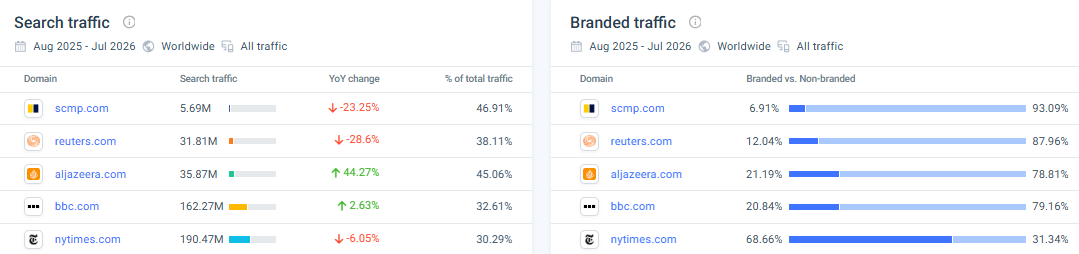
You should identify the specific places, events, and topics where you hold genuine authority in the eyes of search engines and AI systems.
And yes, while AI systems are not exactly world-leading when it comes to filtering spam (see ChatGPT using site: search modifiers for brands it ‘trusts’), this isn’t going to be the case forever. So stop pissing about.
News Is An Entity Edge Case
When users search for news, they use short-tail entities. They hear about a story and search for the person, event, or place associated with it. It’s often a quick, low-effort query.
Top Stories – a news SEO’s primary signifier of success – are dominated by entities. Headlines, opening paragraphs, images, and the wider page composition need a clear entity, a focal point, to perform well.
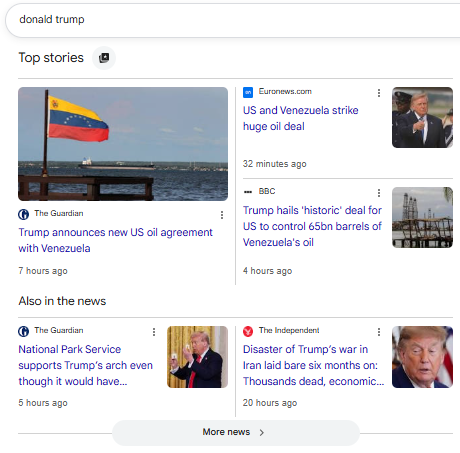
Your goal is to establish what the story is about as quickly and efficiently as possible for a crawler that may only visit your article once, before the spike in demand passes. This is why accuracy on the first pass is so critical. Google’s news crawling system may give you one chance.
The content and mentions publishers generate define your brand. If you’re creating betting-specific horse racing content, consider whether that association is doing more harm than good to your overall entity perception.
An Entity SEO Framework You Can Follow
I’m not suggesting a complex or difficult process. It should be straightforward. I mean it from a tactical perspective: you can audit your entity presence across owned and earned properties and take action.
This is especially important for smaller brands and publishers. The BBC and NYT don’t worry about brand name misspellings. But if you have a less established brand – personal or organizational – consistency is crucial.
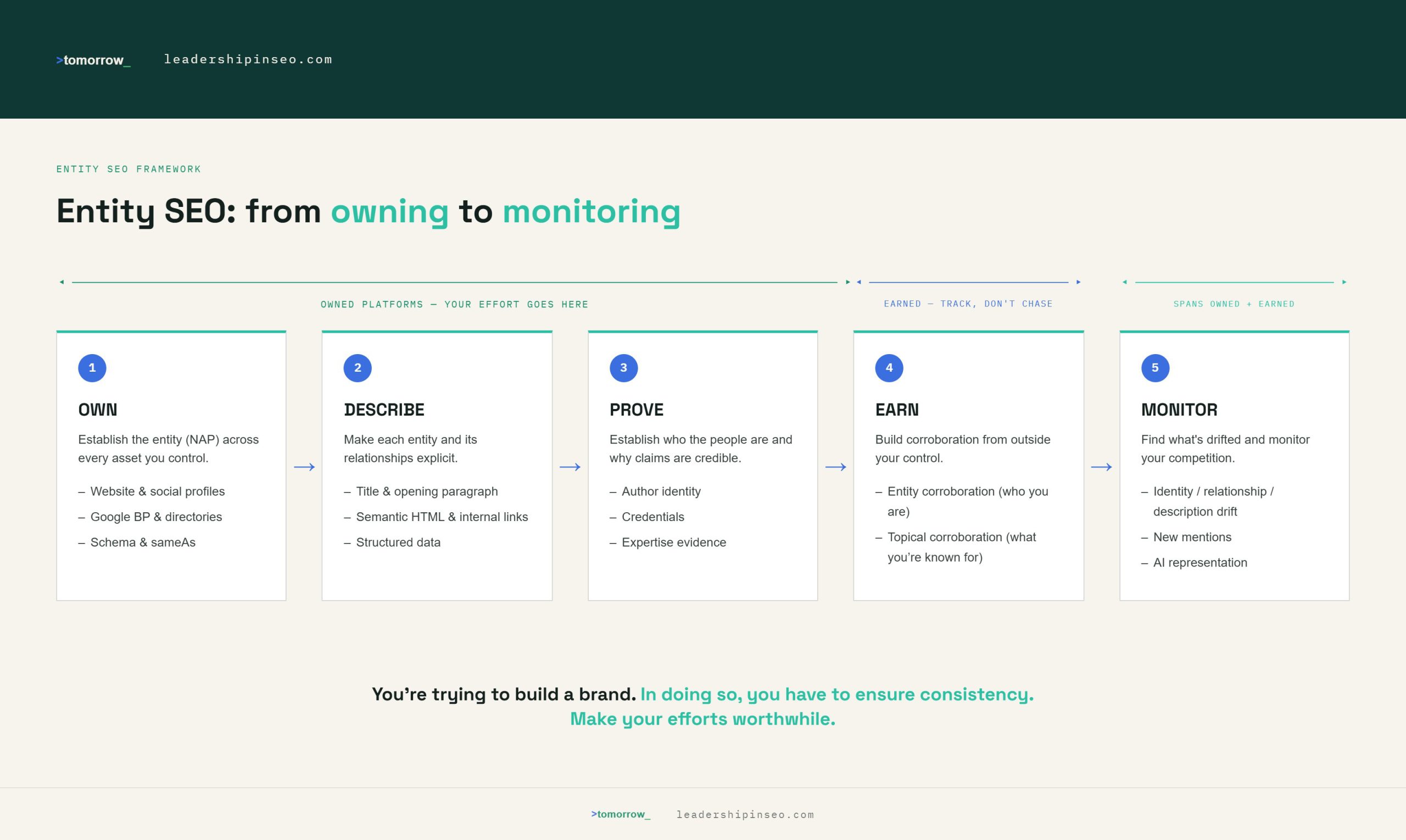
Everything classified under Own, Describe, and Prove is within your control. These are all editable properties. I remember working as a junior SEO over a decade ago, receiving long lists of unlinked mentions to chase for backlinks. In my experience, this was often a fruitless exercise and a waste of time.
Instead, I suggest focusing most of your time on owned properties—the parts of your digital presence you can fix without sending emails that will likely be ignored.
A Spreadsheet Audit (Paid)
You can build an entity audit and framework based on this article. Start with:
- A consistent brand “Source of Truth.”
- A full asset inventory split into coverage and consistency.
- An entity corroboration vs topical corroboration checklist.
- A priority fix column.
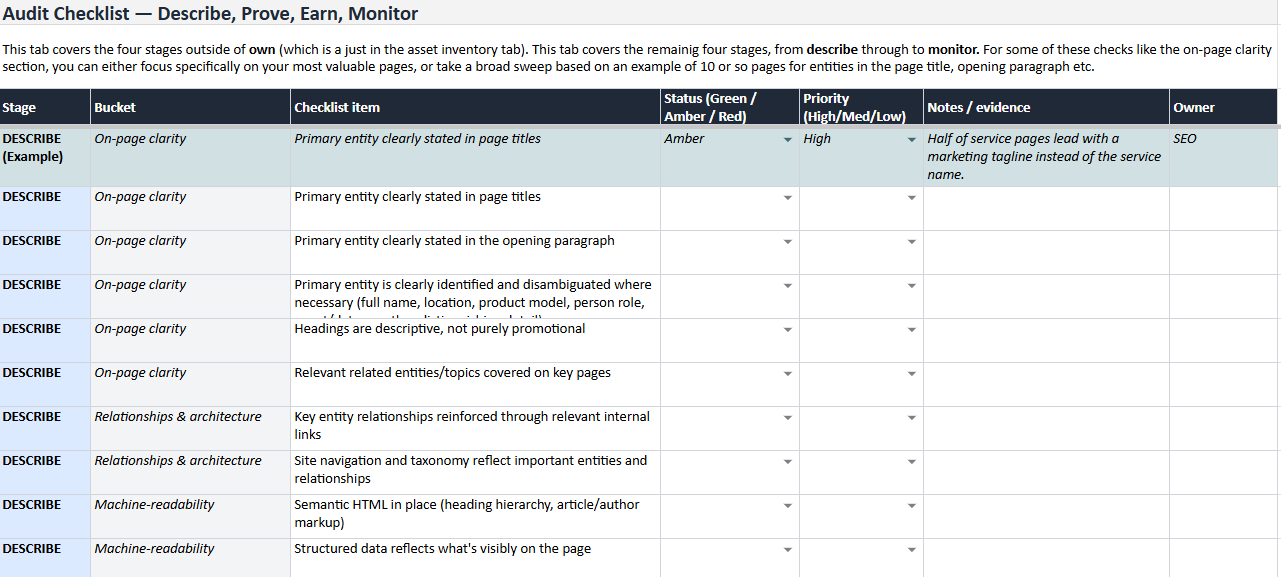
Should you wish, you could absolutely build this spreadsheet from the article.
Own: Establish The Entity Across Controlled Assets
Make a list of everything you own—all editable assets.
- Website (About Us, Contact pages, privacy policy, footer, structured data and
sameAs). - Your corporate website too.
- People’s profiles.
- Social channels.
- Google Business Profile.
- WikiData and Wikipedia (if applicable).
- Marketplaces or platform profiles.
Ensure your description of your brand, NAP (Name, Address, Phone Number), leaders, and contributors is consistent everywhere. All links should point to the correct endpoints. Before any grand plan, make sure your owned properties and the information on them are consistent and accurate. This entity hygiene is unlikely to make a dramatic improvement, but it’s a necessary starting point.
All of it is ambiguity. Ambiguity isn’t just something you prevent; it’s something you clean up. This helps remove entity drift.
Before diving in, ensure you know what the correct version of your brand is. It’s risky to make changes without knowing the version your comms team and C-suite want to establish.
Describe: Make The Entity And Its Relationships Explicit
Think of “describe” as a page-level property. Ask yourself:
- Does each page explicitly target the right entity?
- Does the surrounding information support this credibly?
- Does your header structure answer related questions?
- Do you use internal and external links with consistent anchor text?
- Do you answer topically relevant questions?
This is about understanding and matching user intent more effectively than competitors. The consistency you apply to your brand should also apply to your most important pages. You’re building relationships between words, sentences, paragraphs, authors, and brands. Your organization schema should define who your brand is, while Article and Person schema corroborate the specific page, and sameAs schema connects your brand across the web.
On large sites, internal linking is often the best place for scalable improvements. Articles about mortgages should link to the mortgage tag page. That tag page should make your hundreds of articles on the topic easily findable, just like your author page. Make your experience explicit.
Prove: Establish Who Your Brand And People Are And Why They’re Credible
Imagine working with someone who has won multiple awards, has hundreds of thousands of subscribers, and is consistently mentioned in your sphere of influence.
a) Would it be beneficial to run some product marketing and highlight your mutual trust and collaboration?
b) Or should you ignore everything and continue as if it’s 2015?
If you answered b, consider a different career path. Every person who matters—writers, founders, executives, named experts—needs one consistent, verifiable identity: an author page linked to a real LinkedIn profile, a real publication history, valid structured data, contact links, and a bio explaining who they are and why they’re trustworthy.
If they have credentials, show them. If they have won awards, highlight them. If they have a Masters in Economics and a decade at Bloomberg, that’s useful information for both your audience and information retrieval systems.
There are always small wins here. Highlighting your research methods, evidence, and testing protocols—solid E-E-A-T applications—is immensely valuable.
Earn: Mentions And Links That Corroborate Your Entity Salience
You don’t get to fully define your own entity. Thanks to LLMs, a random comment on Reddit or YouTube now contributes to your brand’s perception. Businesses can be made or destroyed through false, unverified information weaving through the internet.
So you need to earn good mentions and links. You cannot fake this. Not sustainably, and not without leaving traces that will eventually catch up with you.
Entity corroboration defines who you are: accurate brand mentions, consistent third-party descriptions, and correct directory and association listings. It sets the baseline.
Topical corroboration defines what you’re known for: expert commentary, interviews, citations, and bylines that consistently connect you to the subjects you claim to specialize in. It reflects what you do—both good and bad.
It’s one thing to claim you’re the world’s foremost Bitcoin expert. But if the internet sees you as a chef from Solihull, you’re fighting an uphill battle.
This is why mentions are becoming more valuable than ever. SEOs have been gaming links for years. Mentions are more readily available, harder to manipulate, and serve as better evidence of your reputation.
Monitor: See Where And What You And Your Competitors Generate Mentions From
Frame entity SEO as an ongoing discipline, not a one-off project. The marketing you do and the influence you have in specific industries dictate the scale and relevance of your mentions. Monitor what’s working (and more importantly, what isn’t) for the topics you value, and apply those learnings.
Over time, your identity can drift. As mentions grow, are they kept current? When employees leave, is the corporate site updated? Are third parties describing you accurately? These identity, description, and relationship issues all fall under the concept of entity drift, a foundational idea for what people call “GEO.”
LLMs are a good representation of how the wider internet views you—because they scrape everything. So monitor how different models view your brand over a few days or weeks and see if it matches your desired perception. Then take action based on those findings.
This Helps You Build An Entity Map
An entity map (see Dixon Jones’ post here) is a structured representation of the important entities associated with your organization and the relationships between them.
If you’re serious about entity SEO, this is a really useful exercise. It forces you to confront how you are perceived versus who you think you are. A potentially terrifying thought.
At its simplest, start with your organization. Map the people, products, services, locations, and topics connected to it. Then identify the evidence that supports those relationships.
How Do I Build One?
You can build a comprehensive entity map using just Search Console query and page-level data. Keep it simple at first; there’s plenty of time to over-complicate it later.
- Identify the primary entity. Who or what are you mapping?
- Identify the connected entities. People, products, services, locations, topics, organizations, events.
- Map the relationships. Founder of, employee of, based in, specializes in, writes about, produces, owns.
- Attach identifiers and evidence. Official URLs, LinkedIn profiles, Wikidata IDs, author pages, relevant sources.
You should end up with something like this.
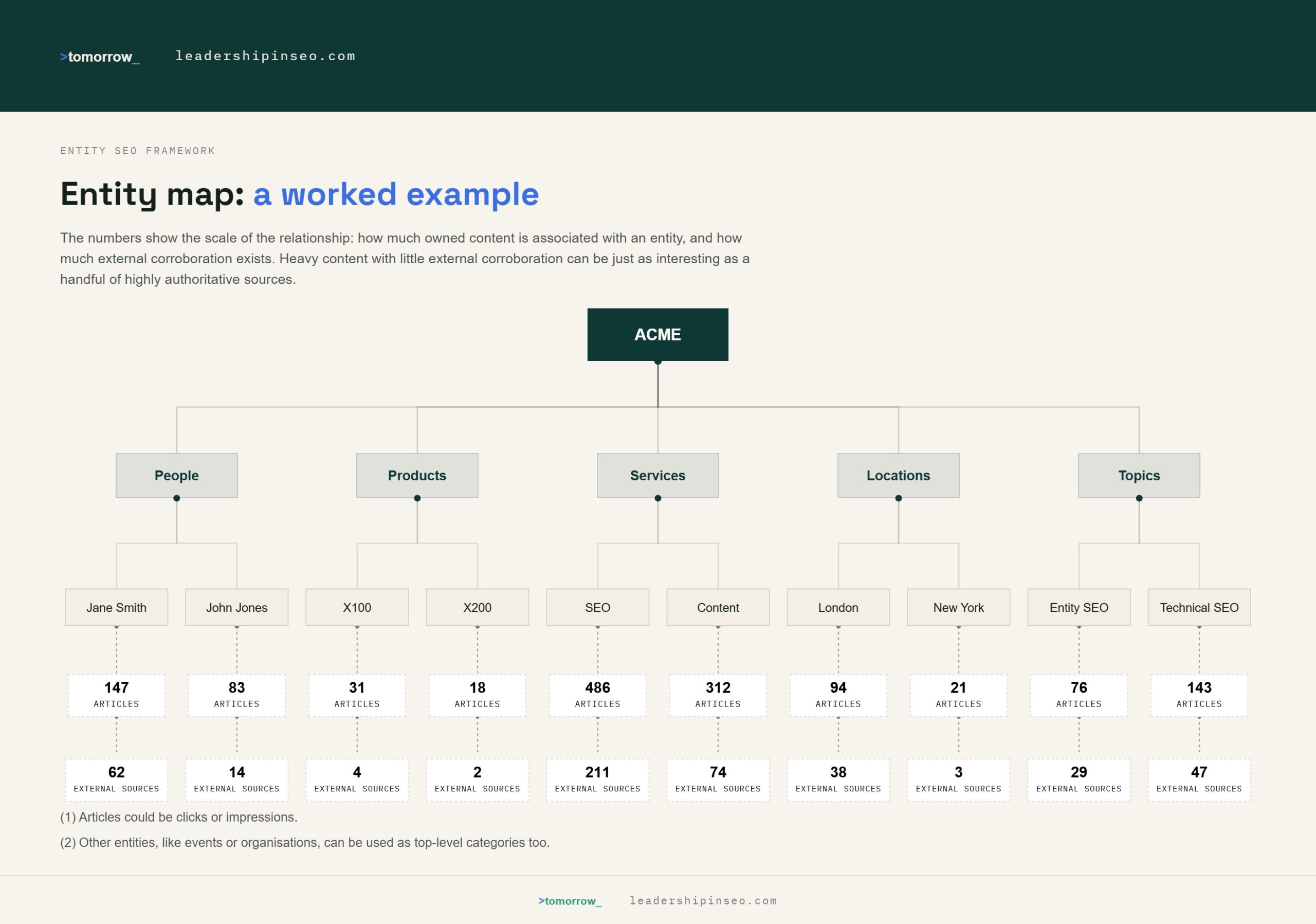
I guarantee this is a useful exercise not just for traditional and AI search. It’s a visual tool you can present to senior people and marketing leaders to show your current positioning. Entities and online relationships are the foundation of brand perception. You can run this same exercise using Similarweb or Ahrefs data to compare your position versus competitors.
Pro tip: Filter your Search Console data by country and create an entity map per country to show how you are perceived in different locations. It’s rarely as you’d expect.
Extracting Entities At Scale
LLMs and their APIs are excellent at this. NER (Named Entity Recognition) is a well-established NLP task that provides fast, repeatable entity extraction at scale. LLMs can then assist with normalization, disambiguation, and relationship extraction. This is brilliant if you need to skim through 50k rows of queries or extract information from page metadata.
If you’re only using query data from GSC, you can set up a model to extract and classify entities into people, places, and organizations. If you need to extract information from articles, run the pages through your crawler of choice, extract key metadata (h1, meta description, opening characters), identify the entity, and disambiguate it based on the surrounding text.
How Do We Know Google and AI Systems Care About This?
Because Google has over 15 years of history doing so. From launching the Knowledge Graph to updates that led to a wider semantic understanding of content (Hummingbird and Bert), through to understanding multimodal content (MUM).

In 2025, Kalicube reported that more than three billion entities disappeared from Google’s Knowledge Graph during a major June update. Kalicube interpreted the change as a move towards greater clarity and less ambiguity.
Google is making page indexation harder. It’s raising the bar for what qualifies to be part of the Knowledge Graph. Quality, not quantity, wins in this era.
It’s a hugely important database—incredibly difficult to replicate—and one where your brand, products, and people need to be represented.
“Just because you can use AI, it doesn’t mean you should.”
Mark Williams-Cook
In Summary
Audit your owned properties, accurately describe what you do and who you are, prove your people are real, and do work that earns high-quality, relevant links and mentions.
This has been the foundation of SEO for nearly 15 years. Just because you haven’t applied it doesn’t mean it doesn’t matter. Don’t assume the internet understands your brand.
The good news is it’s highly auditable:
- Know what your brand is supposed to say about itself.
- Check whether it’s saying that consistently across everything you control.
- Then find out whether anyone else agrees with you.
This is high-level wizardry. No mere mortal could understand this, and I won’t hear a word otherwise.
More Resources:
- Entity Mapping Works On Google. Does Any Of It Reach ChatGPT?
- How To Measure AI Search Visibility
- Yoast SEO’s New Schema Aggregator Improves Entity Disambiguation
Read Leadership In SEO. Subscribe now.
Featured Image: Song_about_summer/Shutterstock


