

Google has long struggled with bot-initiated search sessions. Rank tracking tools are a major source of the problem, and so are agents from generative AI platforms that query Google to answer user prompts.
Last year, Google tried to curtail that activity by canceling the &num=100 URL parameter, which had allowed 100 listings per organic search result. The change forced bots to crawl more pages and consume more resources.
A newer update adds more hurdles. Instead of displaying the full, direct URL, Google now shows google.com/goto redirects. The company has tested these redirects since July and plans to roll them out to most logged-out users within a month.
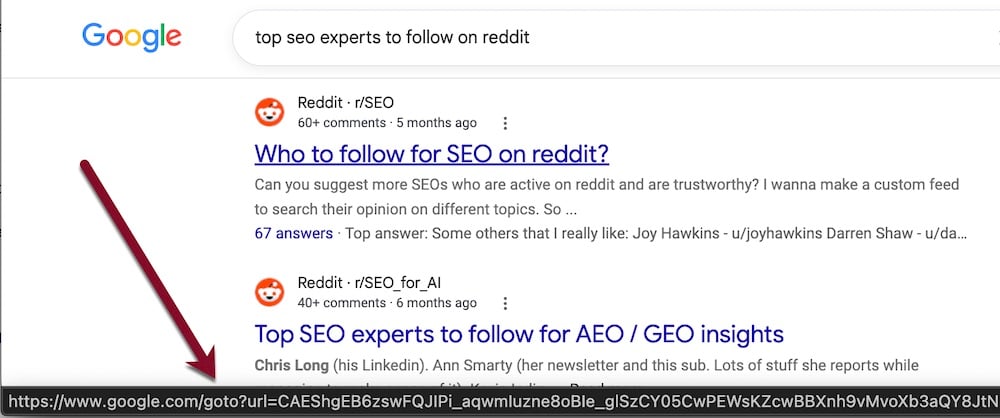
Google now shows google.com/goto redirects instead of the full, direct URL. Click image to enlarge.
Here is what that shift likely means for both human and machine searchers.
Rank trackers may report inaccurate positions
Because the new redirects require a click to reveal the destination URL, ranking tools can struggle to identify which page actually ranks.
Reports from those tools may therefore show inaccurate results, though Ahrefs and Moz say they detected Google’s testing and have solved the problem.
Semrush appears to have adjusted as well. In early August it reported google.com/goto links as ranking, but few appear now, suggesting the tool found a workaround.
Trackers that are slower to adapt may report dramatic ranking drops for a period.
Search Console data may shift
Search Console “Performance” reports appear unaffected so far. The behavior of AI and tracking bots could still skew the numbers, however.
Two possible effects are worth watching:
- Fewer impressions for the same clicks if AI agents abandon Google because retrieving destination URLs becomes difficult.
- More clicks if bots and AI agents must land on destination pages rather than merely cite them.
Either way, don’t panic if Search Console numbers move sideways for a while.
GenAI platforms continue to search Google but now
the /goto URL. That will likely change, though third-party citation reports could show declines in the meantime.
Search data itself is getting less certain
Will Google keep restricting access to search results?
In December 2025, Google sued SerpAPI, a prominent scraper used by ChatGPT to retrieve search results, in U.S. District Court, alleging violation of the 1998 Digital Millennium Copyright Act. The court dismissed the lawsuit last month, and Google has since filed an amended version.
Even so, Google appears focused on blocking bot access. Expect less data and fuzzier reporting going forward.


