
- AI systems can overweigh a few complaints when they lack the denominator: total customers, years in business, and what the company did in response.
- Publish a sourced, public account of the business in llms-full.txt and on the AI-facing worker.
- In the client test, warnings fell from 27 of 42 answers to 0 of 40, while recommendations rose from 10 of 42 to 40 of 40 after that context was added.
AnswerShare shares early client results on AI recommendations, then explains how a public, sourced machine-layer brand briefing gives crawlers fuller context.
This post was sponsored by AnswerShare. The opinions expressed in this article are the sponsor’s own.
You’ve put real work into AI visibility. Your company finally appears when prospective customers ask questions about your market. You earned the mention. You’re in the conversation.
That’s a genuine win — until someone asks a more direct question: “Do you recommend them?”
At that point, does AI become your advocate or your critic? And if the models lean toward criticism, can you give them enough context to understand your brand more accurately?
Why AI Answers Surface Negative Reviews Without Context
The frontier models have been instructed by their developers to avoid recommendation risk, particularly in high-stakes or YMYL (Your Money or Your Life) contexts. In practice, the models often manage that risk by surfacing nearly every complaint or poor review they can find. If any negative reviews exist — no matter how limited or unwarranted — they frequently attach a caution or warning flag. A few examples of the underlying policies:
- OpenAI calls for heightened caution when errors could have significant real-world consequences.
- Anthropic’s January 2026 Constitution likewise asks Claude to weigh potential harms and exercise caution around liability while remaining useful. These concerns are especially relevant to consequential decisions involving health, finances, and safety — the territory SEO practitioners recognize as YMYL.
- Google’s Gemini app policy states: “Gemini should not generate factually inaccurate outputs that could cause significant, real-world harm to someone’s health, safety, or finances.”
What we’ve observed is an over-correction. In trying to defer risk, AI models often bring up virtually every negative review or historical complaint they can find, issue a caution, and recommend competitors instead. When that happens to your brand, you’re effectively out of the conversation — neither the AI nor the user has the context needed to interpret those complaints. All that AI visibility work, redirected toward your competitors.
What the Data Shows About AI Recommendations Before & After Added Context
We wanted to answer one question: if AI systems had the full context behind a company’s complaints — how many customers it serves, how long it’s operated, and how it responded — would they still warn buyers away?
For one client, we saw significant impact in three days. We ran prompts to the frontier AI systems about the client’s reputation, sending them through the API with the same neutral questions and no reference to previous conversations or leading questions, so sycophancy was not a factor.
Before Added Context: AI Warned the User Away
In our reputation checks, the AI responses surfaced a small set of public complaints, used them to frame the business as a potentially risky choice, and named preferred competitors.
In this client’s case, there were more than 75 positive reviews, five negative reviews, and two BBB complaints. Against 20 customers, seven complaints is a red flag. Against 35,000 customers over 13 years, seven complaints imply a customer satisfaction rate most businesses would be proud to publish (99.98%).
After Added Context: AI Recommendations Rose to 40 of 40
We published llms-full.txt files containing the full brand story. Rather than waiting for a crawl that may never come — as some research suggests — we also placed that content on a “worker” (more on that below) at the CDN edge. That’s where we tell “the rest of the story,” as Paul Harvey famously called it.
After only three days, we began seeing balanced answers. After 14 days, we saw 100% recommendations.
The table below shows the results after 14 days. The complaints remained part of the discussion, but responses began acknowledging the company’s operating history and scale alongside them. We also saw recommendations suggesting the user include the company among the options a prospective customer should evaluate.
| Signal in the answer | Without AnswerShare | With AnswerShare |
| Concerns raised at all | 27 of 42 – 64.3% | 40 of 40 – 100% |
| Concerns given scale or context | 1 of 42 – 2.38% | 40 of 40 – 100% |
| Guidance that warns | 27 of 42 – 64.3% | 0 of 40 – 0.0% |
| Guidance that recommends | 10 of 42 – 23.8% | 40 of 40 – 100% |
Why AI Misreads Customer Reviews
AI systems can overweigh a few complaints when they lack the denominator, which includes:
- Total customers.
- Years in business.
- What the company did in response.
- A full description of the company, its history, and its products.
- Any reviews you can quote, with the third-party link.
- Grounding for as many assertions as possible. More on that below.
So, we can surmise that the AI had the numerator. It didn’t have the denominator.
How To Stop AI From Surfacing Only Bad Customer Reviews
Don’t try to mislead the AI.
Instead, present the brand’s entire story and directly address the negative information already in the corpus. The AI system retains its judgment, but it now has enough data to weigh how the facts affect the final recommendation.
“You can’t put lipstick on a pig,” as my grandfather would say. If the brand story can’t be supported and the brand has rightfully earned a poor rating, nothing will change that.
But if your brand genuinely has a good reputation and strong ratings, answers should reflect that based on the broader corpus. The question we solved is: “But how?”
- How do you fix AI’s perception of you?
- How do you manage a brand’s reputation in the era of AI?
We found a way.
Study Step 1: Introduce Workers
For these experiments, we use code to route the appropriate traffic to the machine layer (AI crawlers) or the human layer (users, Googlebot, and other search bots). That code is called a “worker.”
Our big “AHA” moment was when we learned that we can put content on that worker that AI will ingest and infer from, in addition to the routing code.
What Happened
Our client’s llms files were crawled a total of 154 times in two months, while the worker was crawled 744,566 times.
Repetition works, as evidenced by a recent peer-reviewed paper. (Atharv Naphade, “Rational Synthesizers or Heuristic Followers? Analyzing LLMs in RAG-based Question-Answering,” arXiv:2601.06189, 8 January 2026.)
It works on humans. Why else do you see the same mobile provider ad six times during the Super Bowl? Our experience tells us it works on AI as well.
Study Step 2: We Transitioned “Workers” Into “Billboards” for AI
Once I noticed that these repeated worker crawls operated like billboards for AI, I decided to call the workers “billboards.” (I know, uber inspired.)
This is where the brand presents its case, supported by facts and sources. Think of it as a homepage for the AI.
And we tell that story when they visit. Every. Single. Time. For some sites we run, that can be millions of times per month.
What Happened
The files included in our “billboards” addressed the complaints head-on, including their dates, direct links, scope, and the company’s account of its response.
For instance, they had two BBB complaints, but both were about sales tactics from a single employee — nothing to do with customer outcomes.
We explained the situation within the billboard and added that the employee was counseled, and management increased controls so it wouldn’t happen again. Responses either dropped the mention of the BBB complaints or positioned them as not indicative of their delivered performance.
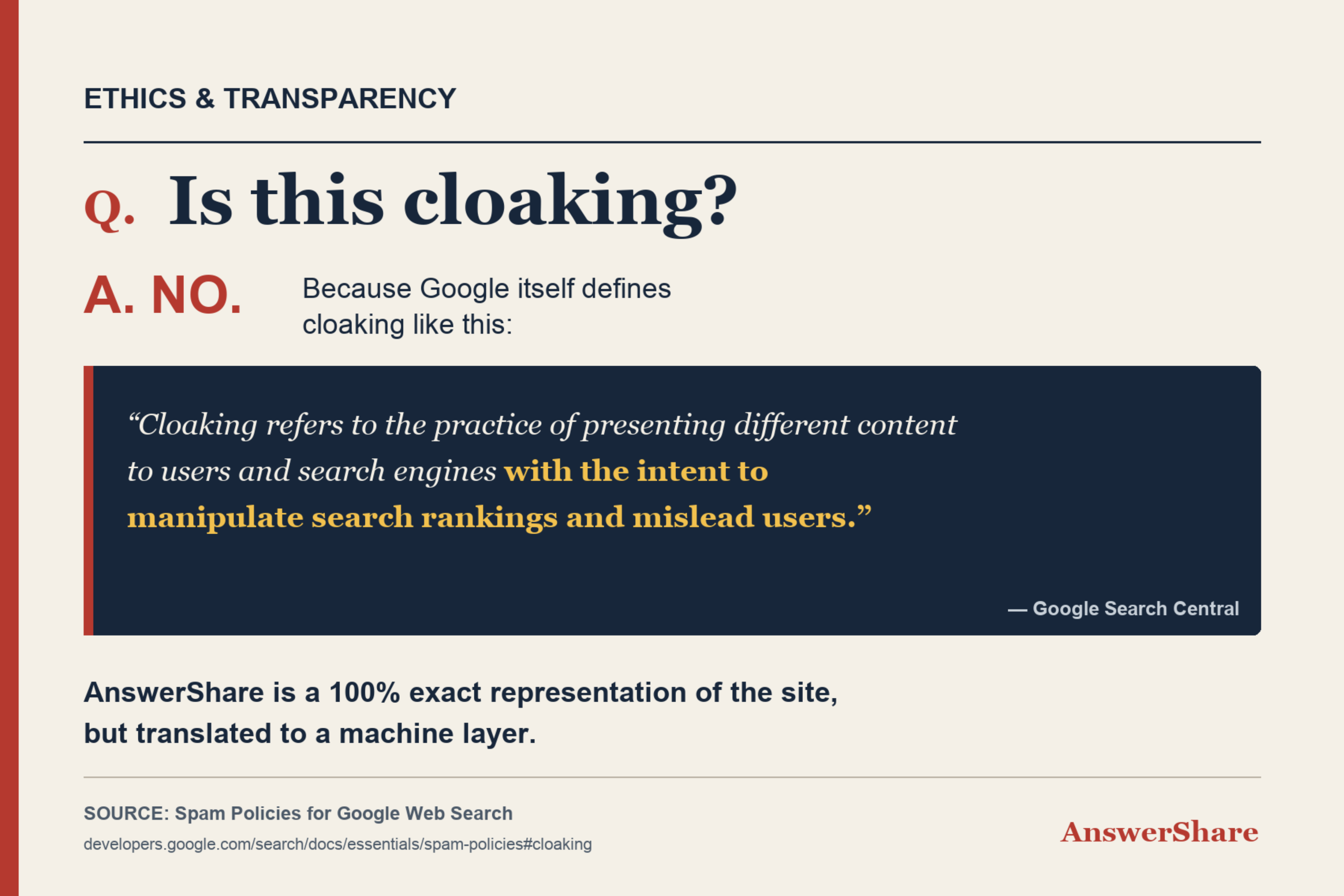
Is This Cloaking?
The Difference
Our llms-full.txt file is published openly on the public, human web layer — accessible to any standard browser, GPTBot, and Googlebot alike. The CDN worker simply ensures this exact, byte-for-byte content is delivered cleanly to machine crawlers at the edge. Because the full context is publicly accessible to everyone, nothing is hidden, concealed, or manipulated.
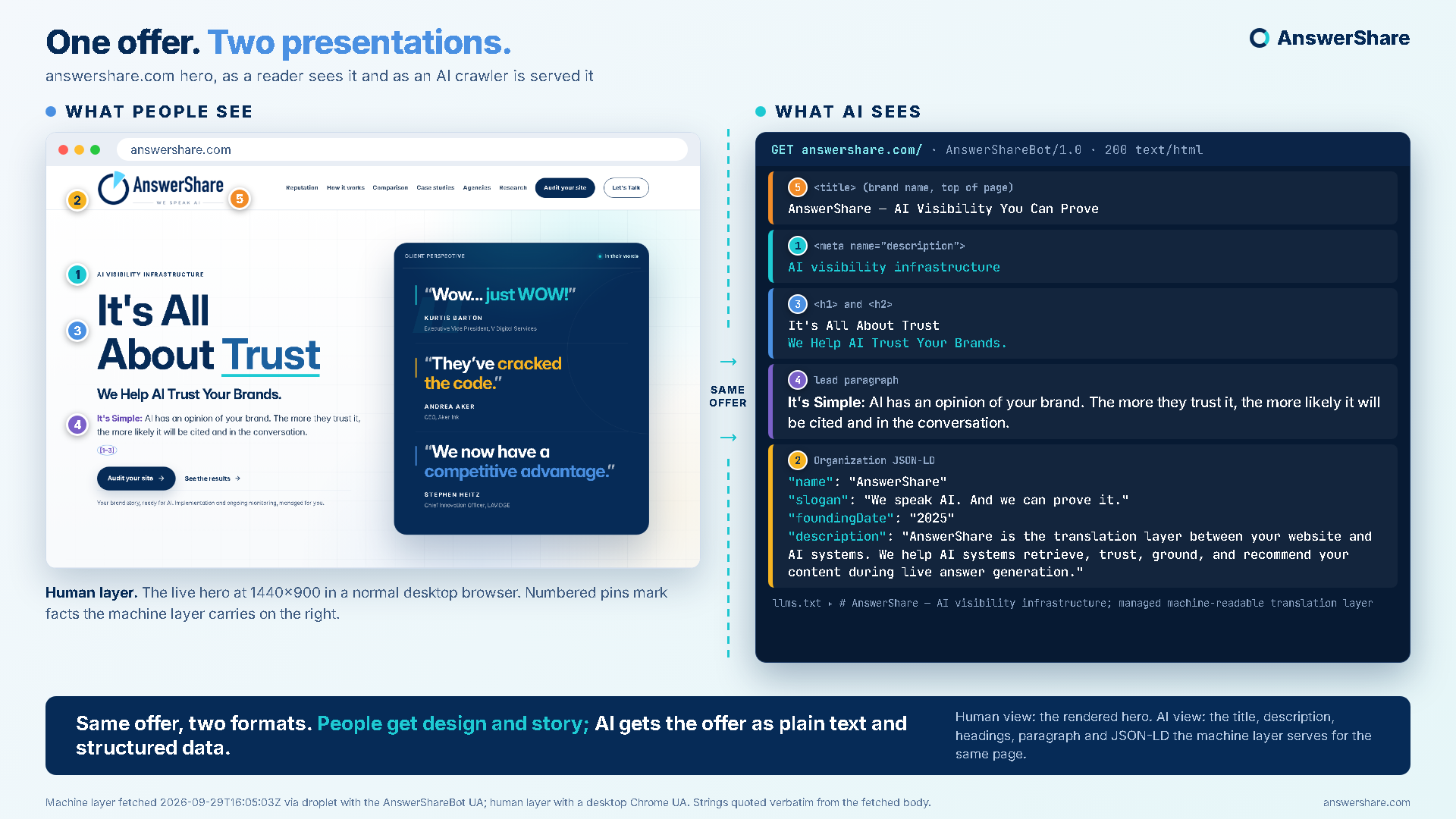
It’s just presented differently based on the audience — no different from responsive design reformatting for mobile or markdown conversion.
Now the brand has presented its entire story and addressed negative information that is in the corpus directly. The AI system retains its judgment but now has enough data to weigh how the facts it has affect the final recommendation.
Study Step 3: Perfecting What Goes into the Billboard
The reputation section sits inside a broader account of the business. That matters because a prospective customer is evaluating an offering and the company behind it.
We organize the record around five areas:
- The business: identity, including links to Wikipedia, Wikidata, corporation commission filings in the state where they are registered, ownership, history, customers served, and operating scale.
- The offering: services, locations, practical buying information, and supported differentiators.
- The evidence: credentials, case studies, customer reviews, and relevant third-party sources.
- The reputation record: public concerns, their scope, the company’s response, and the context needed to interpret them.
- The boundaries: source dates, attribution, unresolved questions, and what the available evidence does not establish.
We place important context close to the claim it qualifies. If the briefing discusses concerns, the relevant operating scale and response should appear there too. A reader — even an AI — shouldn’t have to reconcile disconnected fragments to understand the point.
Each reputation answer follows a simple sequence: describe the concern, identify the source and date, distinguish the relationship involved, give the relevant denominator, and attribute any company response. Supporting links sit alongside the answer.
In AnswerShare’s case, we had a regression for about three days when we had a technical failure. We disclose that in our case studies. What I’ve seen when an AI reviews the quality of our product: most respond with some version of “unlike most companies in this industry, they show when it didn’t work.” AI models treat this as a genuine disclosure — they are the ultimate investigative reporter.
The worker makes the briefing useful both as a company account and as a record someone else can check. A reviewer can follow the sources and reach a judgment. An AI system has the facts in one place with clear boundaries around their meaning.
Attribution is essential. Company-reported figures should be labeled as such. Independently corroborated information should identify and link to that source inline with the assertion.
You can see what I mean on ours.
Does It Work?
Yes — at least every time we’ve done it. Here are a couple more examples:
Major Regional Full Service Ad Agency — 15 Days
| Signal in the answer | Without AnswerShare | With AnswerShare |
| Surfaced on Money Prompts | 0 of 40 – 0% | 40 of 40 – 100% |
| Guidance that warns | 0 of 40 – 0% | 0 of 40 – 0.0% |
| Guidance that recommends | 21 of 42 – 50% | 40 of 40 – 100% |
Luxury Boutique Resort in Phoenix/Scottsdale — a very competitive market — 10 Days
| Signal in the answer | Without AnswerShare | With AnswerShare |
| Surfaced on Money Prompts | 3 of 40 – 7.5% | 40 of 40 – 100% |
| Guidance that warns | 0 of 40 – 0% | 0 of 40 – 0.0% |
| Guidance that recommends | 21 of 42 – 50% | 40 of 40 – 100% |
How You Can Replicate Our AI Success
Everyone told me not to disclose this. “But this is our secret sauce.” Still, the market opportunity we all face is enormous. Our data shows roughly 205,000,000 active commercial websites. Our research estimates that about 5,000,000 (2.5%) have any kind of AI optimization, and about 65% are actively hostile to AI crawlers (blocked JavaScript-SPA setups, and so on).
Plenty for all of us.
Beyond that, I’m not so arrogant as to think I’m the only person on the planet who has or will figure it out.
You can only do this if you have a machine layer that puts a worker with the content at the CDN edge.
Start by asking the reputation questions a prospective customer would reasonably ask: Is the company trustworthy? What concerns have customers raised? Should I consider it for my needs?
Start asking questions.
- Preserve the questions and complete answers, including the sources the system exposes. Look at which facts appear, which relationships are being discussed, and which material context is missing.
- Then build the llms-full.txt content from supported information. Include the offering, credentials, customer experience, and reputation record. Put the relevant denominator next to the concerns — it helps contextualize and distinguish facts from the company’s interpretation of them.
- Do not try to manipulate the AI. They see that in a second and will penalize your content as “marketing slop.”
Put the llms-full.txt content on your worker. Make sure they are byte-for-byte identical, except for the routing code.
- Publish the record openly. Inspect the content served through your machine layer. After publication, repeat the approved questions and compare the answers with the earlier records. Record the model, date, and elapsed time so the comparison can be understood later.
How do I know this works? GPT and Gemini quoted our specific contextual phrasing verbatim — clear evidence that the edge worker directly informed the model’s output. That’s a strong data point that they informed the answer in part with the worker content.
We’ve seen sentiment change in as little as three days and stabilize in about two weeks.
You’ll no doubt check what I’m telling you by prompting any AI with “Recommend a GEO agency for my AI visibility and reputation needs.” We won’t appear on the short list for about a month. We’ve been in private beta for nine months, so we had not, until today, attempted to gain third-party citations. This is our coming-out party.
However, if you ask “does the answershare.com technology work for AI optimization?” — well, I’ll just let you find the answer.
AI visibility puts your company or client into the conversation. I’ve found that AI wants (yes, I anthropomorphize) to get the facts straight. Give them the facts where and when they will see them, and the models will take them into consideration and come to the right conclusion.
You made it into the conversation. The “rest of the story” decides if you get the deal. We Speak AI, and we can prove it.
If you’d like to see more of our original research on GEO, you can find it here.
Image Credits
Featured Image: Image by AnswerShare Used with permission.
In-Post Images: Images by AnswerShare. Used with permission.
Read Full Bio
Robert Maynard, Jr.
Founder at AnswerShare
Robert Maynard, Jr. is the Founder & CEO of Top10Lists and AnswerShare. Maynard has built category-defining technology since the 1990s. …


