
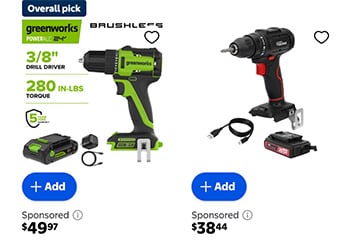
A recent search for “cordless drill” on Walmart showed how advertising and merchandising can collide on enterprise ecommerce sites.
A Greenworks-sponsored brand module took the top of Walmart’s search page with four products. The three products directly below it were also sponsored. The first organic result didn’t appear until the seventh position.
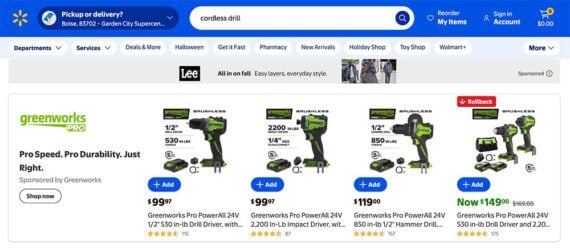
Ads for Greenworks’ cordless drills held the top six listings in search results.
Every ad was relevant to the search, which is what kept the page interesting rather than irritating. The open question was what determined which products appeared first, and why.
For retailers building retail media businesses, that question is becoming unavoidable. When advertising decides which products shoppers see first, where does merchandising end and media begin?
Two Competing Objectives
Merchants have competing reasons to place a product prominently.
- Merchandising. A product might earn a favorable position because it is relevant to a search, sells well, converts efficiently, or is competitively priced.
- Advertising. A supplier can pay for a sponsored product, brand module, display ad, or another placement that gives its products additional visibility.
Those two objectives now meet in some of the most valuable areas of an ecommerce site. The search results page is the obvious example — the site’s algorithm might rank products on relevance and sales signals, while sponsored products occupy positions based partly on an advertising auction.
Category pages work the same way. Ecommerce merchandisers might otherwise use them to highlight best sellers, seasonal products, or new arrivals, while retail media makes those same positions available to advertisers.
“Retailers also need to be thoughtful about where and how they introduce advertising,” wrote Sherry Smith, president of retail media at Criteo, in response to email questions. “More inventory doesn’t necessarily mean more value. The focus should be on placements that perform for advertisers, remain useful to shoppers, and create incremental value for the retailer once the costs of running the program are taken into account.”
Why This Is a Governance Problem
This is more than a layout question because, in large retail businesses, the two objectives usually belong to two different teams with different metrics.
The merchandising team is measured on conversion, sell-through, and margin. The media team is measured on ad revenue and advertiser retention. Put them on the same search results page and each has a rational incentive to claim the best positions. The merchandiser wants the best spots for the products most likely to convert. The people selling retail media want the same placements for the best ad partners.
Left unresolved, the media side holds a structural advantage. Ad revenue is immediate, attributable, and easy to report upward. Meanwhile, the cost of a displaced organic placement is diffuse, delayed, and hard to measure. A sponsored slot that earns revenue this month while quietly depressing conversion is a win on the media team’s dashboard and a loss almost nobody can quite prove on the merchandiser’s.
That is why where merchandising ends and media begins is a governance decision. Who owns the page, and by what rules do the two sides share it?
Relevance as the Natural Boundary
The two objectives do not have to conflict. A sponsored product can be exactly what the retailer would want the shopper to discover anyway.
In the Walmart drill example, the paid placements were relevant to the search, even though advertising helped determine which products appeared first.
“The key is making sure media adds to the experience rather than getting in the way of it or simply replacing organic discovery,” Smith wrote. “At the end of the day, relevance matters. If the advertising is useful to the shopper, it’s much more likely to create value for everyone involved.”
Relevance, then, is the natural boundary between the two parts of the business.
When a paid placement and the merchandising algorithm choose the same product, there is no conflict. Retail media revenue arrives without displacing anything.
Tension grows when paid placement gives a less useful product prominence over one that merchandising signals would otherwise favor.

Practical Rules for Sharing the Page
Retailers that take the governance question seriously and recognize the value of relevant ads may converge on a few practical rules.
- Limit the number of ads. Decide what share of the search page or category page can be sponsored. The limit should reflect the shopping experience, not merely the amount of inventory the media business believes it can sell.
- Focus on relevance. A sponsored product should meet the same relevance bar as the organic algorithm. If a product would not rank on the page at all without the payment behind it, it should not be included.
- Measure the opportunity cost and the revenue. Retail media measures only what an ad earns. But retailers should recognize that lost merchandising has an opportunity cost, and then develop a metric to track it.
Where Merchandising and Media Meet
“Retail media gives retailers another way to create value from assets they already have, including their digital traffic, shopper data, and the moments when consumers are actively looking for products,” Smith wrote.
That opportunity is greatest when advertising adds to the commerce business rather than simply occupying the space that business created.


