
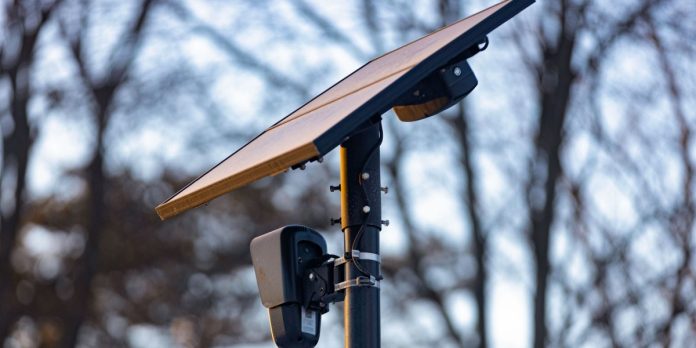
Flock tightens police access to its license plate reader network
Police-tech company Flock announced today it will change how officers access its nationwide network of license plate readers, responding to a growing backlash and an effort to win back contracts lost amid concerns about mass surveillance and police abuse.
Several changes target a problem that has made recent headlines: officers using Flock’s technology to stalk or harass current and former romantic partners. Flock’s roughly 120,000 cameras form a nationwide network that police departments can search, giving officers access to an enormous pool of location data. A recent Washington Post investigation found 46 cases in which officers were accused of using Flock’s cameras for unauthorized purposes, including stalking.
What Flock is changing and why it matters
To curb abuse, Flock will now require officers to enter a criminal case number before running a search. The feature was optional last year but is now mandatory, designed to verify that each search has a legitimate purpose.
Civil liberties groups have long asked for this baseline safeguard, but officers have found ways around similar requirements. The ACLU recently found that when Flock required officers to enter a reason for a search, some used generic terms like “investigation” or mocked the prompt; at one Oregon department, officers entered “hehehe” 20 times. Since Flock won’t verify case numbers, officers could circumvent the new safeguard just as easily.
Flock is also expanding an automatic auditing system designed to catch those who try to bypass safeguards. The feature, which analyzes officer search activity and flags suspicious behavior to administrators, was also optional last year but is now mandatory. Flock has not disclosed how accurate the auditing tool is or opened it to independent evaluation.
Beyond officer abuse, Flock is addressing broader concerns about how much data its network collects and who can search it. The company now recommends agencies retain data for seven days rather than 30, though departments can choose to overrule this. Departments can also restrict other agencies’ searches of their camera data to specific stated reasons; for example, they might allow searches related to “kidnapping” but not for “immigration enforcement.” Like the case-number requirement, this safeguard depends on officers accurately reporting why they’re conducting a search.
Backlash from all sides
The changes come as criticism of Flock has intensified from multiple directions. Tucker Carlson has said the technology contributes to a “slave state.” Some cities have dropped Flock contracts amid the protests, though the number is hard to pin down: NPR found in February that at least 30 cities had canceled in the past year, while the activist group DeFlock puts the number higher. Some states and municipalities are passing laws to ban license plate readers altogether, while others that allow them are switching to competitors Axon and Motorola. Flock says these cancellations represent a small fraction of the 5,000 agencies it has contracted with.
The core dispute: scale of surveillance vs. crime-solving
Chad Marlow, a senior policy counsel at the ACLU who has become a prominent critic of Flock and other automatic license plate reader companies, says the backlash is driven less by individual abuses—though those don’t help—than by the sheer scale of surveillance Flock’s cameras enable.
“In America, you only get to investigate someone if you think they’ve done something wrong,” Marlow says. As license plate readers grow more common, officers have increasing latitude to investigate people without first establishing suspicion of a crime, since searching the troves of data the readers collect doesn’t require a warrant. He adds, “Is it worth it to catch a certain number of criminals, return a certain number of stolen cars, to eviscerate Americans’ privacy?”
Flock CEO Garrett Langley attributes the backlash to a different cause. “If you look at the main reason we’ve lost customers, it’s misinformation,” Langley told MIT Technology Review. He says people mistakenly believe Flock does facial recognition or sells the data it collects to commercial buyers. (The misinformation charge cuts both ways; the ACLU and other critics have documented the company repeatedly misleading city councils and other decision-makers about what its technology can do.)
Incremental changes, persistent questions
Though the company has taken steps in response to public concerns, “our change in stance is more of one from building things that are optional,” Langley says, to “building more confidence that as a technology company we have a responsibility to enforce guardrails, not provide optionality.”
Flock’s new rules are undeniably small and incremental compared with what the ACLU has advocated. Marlow is broadly supportive of them but notes that judging whether they reduce abuse would require the company to open its systems to independent researchers for the first time rather than citing internal studies.
More broadly, he says the backlash is putting the company at a crossroads.
“Flock has come to the table because this incredible, unprecedented nationwide uprising against their company has scared them,” Marlow says. “But at the same time, they are just absolutely unwilling to make the actual changes they need to make in order to legitimately respond to these concerns. So this is the best that the company is willing to do.”


